
Charter Communications Pushes Out TiVo Deployment Schedule

Charter Logo On Monday morning cable MSO Charter Communications (who happen to be my MSO, BTW) reported their 4Q11 financial results. But I’m not concerned with their results in general, rather I’m interested because Charter is one of the cable MSOs signed on to distribute TiVo to their customers. Charter is joining RCN, Suddenlink, and Grande Communications, who already have ongoing deployments.

Right now Charter has TiVo commercially available in Fort Worth, TX, and in trials in five additional markets. They’d previously stated that they planned to have a full TiVo launch enterprise wide in the first half of 2012. However, it looks like, while things are going well, they now expect to need a bit more time to reach that goal. On the call Charter EVP and Chief Financial Officer Christopher Winfrey stated, as transcribed by Seekinig Alpha:

Our four strategic priority for 2012 is to change the dynamic in our video business. We’ve deployed a version of the TiVo product in Fort Worth and are working with TiVo to field-test the product in several other markets with our employees. We don’t expect that testing will be completed in time for us to fully launch TiVo across the enterprise by the end of the second quarter as previously projected.

Later, during the Q&A, new President & CEO Thomas Rutledge stated:

And TiVo, I’ve always thought it was a fabulous user-interface, and I’m glad to see that Charter and TiVo have been working together to bring that user-interface to our customers and so, as we work through those issues, I’m excited by the way TiVo can present information to our customers.

Later, when asked directly about the push out in the timeline, EVP Technology and President Commercial Services Donald Detampel responded:

I can respond to that. So first of all, I just want to echo Tom’s words, I mean, we remained very committed to the TiVo platform. We believe that the experience it delivers to our customers is superior than anything we have in the market right now; so we remain very committed. In our particular that the integration of the TiVo platform into our platform, basically we had different VOD systems than TiVo had integrated in the past. So what we’re working through are some of those integration issues, but we had previously believed that through the first-half of this year that we’d be pretty well implemented across the enterprise. We now know based on our testing that we will require some further field testing, and we’re not going to deliver that product to our customers until we know it’s fully baked and right.

So it really sounds like the issue is just integrating the various VOD back end systems that Charter uses. Charter has multiple different VOD systems in different service territories. I believe they’re using SeaChange in Ft. Worth, which is a system TiVo has previous experience with at other MSOs. So Charter may be able to deploy TiVo in territories where they’re using systems already successfully integrated with TiVo, while adding more time to the schedule to complete integration and testing of different systems for other service areas.

Overall it sounds like Charter remains committed to TiVo, and these delays aren’t too surprising or unusual. Needing more time to fully polish a new integration effort isn’t exactly unheard of, and I’m sure both Charter & TiVo would rather take the time to get things right than to deploy a problematic system to customers. Perhaps the extra time will also mean Charter will launch in some markets with the Premiere Q & Preview instead of the base Premiere, which is used in Ft. Worth. Time will tell.
Posted in Cable, DVR, TiVo | Tagged , , , , | 1 Comment

ASUS Officially Launches the PadFone & Two More Transformer Models

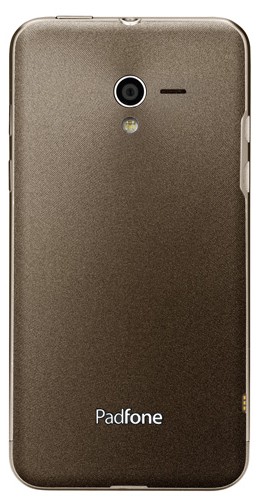
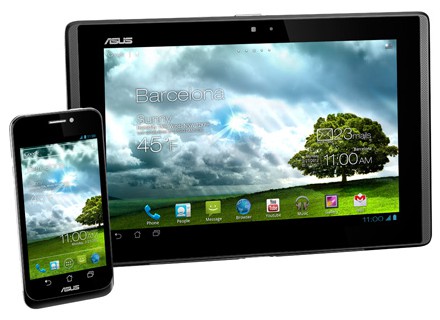
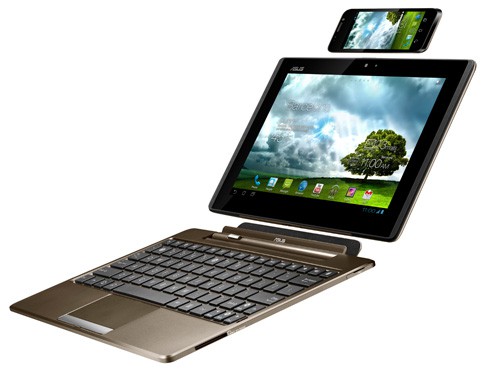
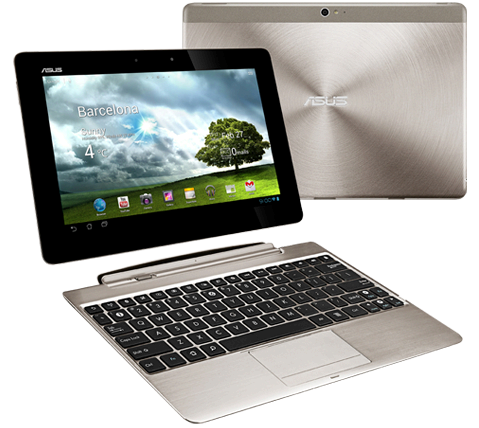
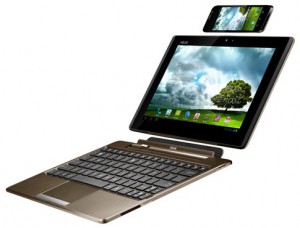
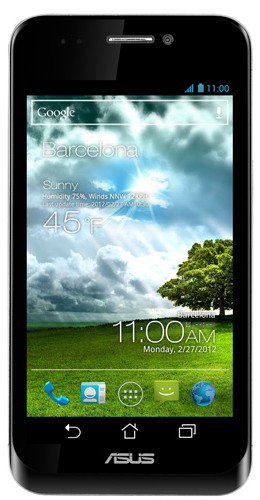
ASUS PadFone Station with keyboard ASUS has been teasing us for a while with the PadFone concept, but now it is official, and coming in April. As a refresher, the idea of the PadFone is to have one computing device – the phone – instead of multiple devices. The phone contains the CPU, RAM, storage, networking (WiFi, Cellular, and Bluetooth), cameras, and the primary display.

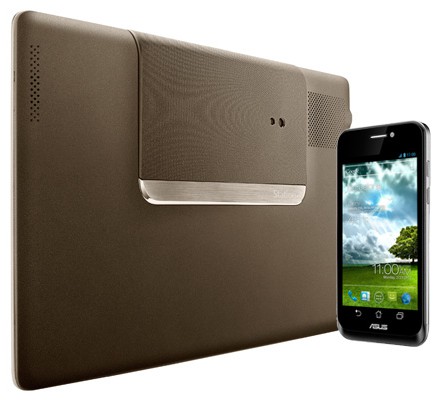
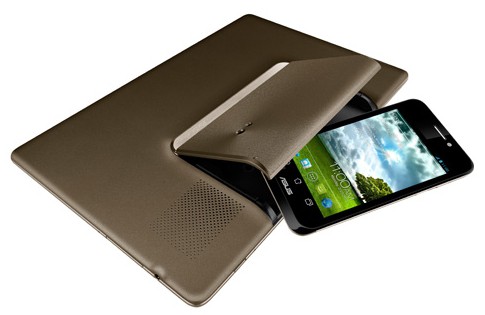
When you need a larger display the phone docks with a tablet. But the tablet is really just a screen and larger battery – it has no native processing capability. Instead the phone provides all of the power. That means no need to install apps twice and keep them in sync, or to have two data plans, etc. The tablet is just a ‘sleeve’ for the phone.

ASUS takes this even further with the PadFone, building on their Transformer products, but having the tablet dock with a keyboard. So the phone becomes a tablet becomes a netbook.

The PadPhone has a Qualcomm Snapdragon S4 8260A Dual-Core 1.5 GHz CPU, 1GB RAM, 802.11b/g/n WiFi, Bluetooth, and 16/32/54GB internal storage with a microSD slot for expansion. It has a rear 8MP camera with flash, though the front camera is listed as only VGA (.3MP) which is a little disappointing. The dimensions are 128mm x 65.4mm x 9.2mm with a weight of 129 grams. The display on the phone is 4.3″ qHD (960×540), which is respectable, though it’d be tough to give up the 720p display of my Galaxy Nexus.

The magic happens with DynamicDisplay, a special feature developed by ASUS. It dynamically resizes apps as the PadPhone is docked with or removed from the PadPhone Station. Not only do you get a 10.1″ 1280×800 display, but apps with optimized tablet views, such as Gmail, will change. So you won’t just see the phone display blown up, but the proper tablet view.

When docked, the PadPhone’s camera and flash are still used, but the front camera is replaced by one built into the tablet. What’s not clear from the specs and images is which ports the Station dock has. The keyboard dock looks very similar to the one for my Transformer Prime. Like the Prime’s keyboard it adds additional battery, as well as a full size USB port and full size SD slot.

This looks like a very interesting product. I’m not sure if I’d give up my Galaxy Nexus phone and Transformer Prime tablet for the PadFone, especially since I’ve really only just picked up both. But down the road when my G-Nex is up for replacement I’d certainly look at the then-current generation of the PadFone. This is exactly the kind of design I’ve been waiting for.

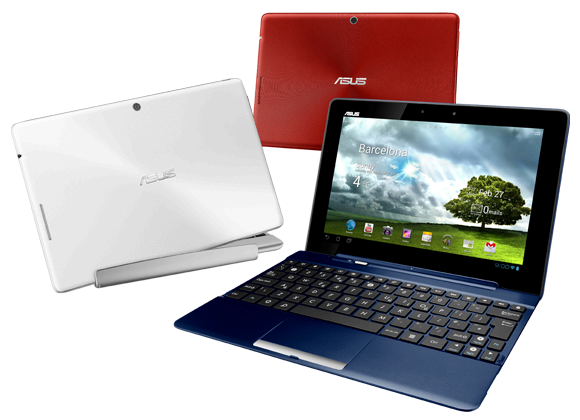
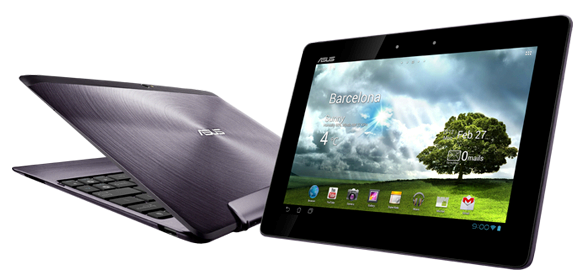
ASUS also announced that the Eee Pad Transformer line is bring rebranded as the Transformer Pad, and two new models are being introduced.

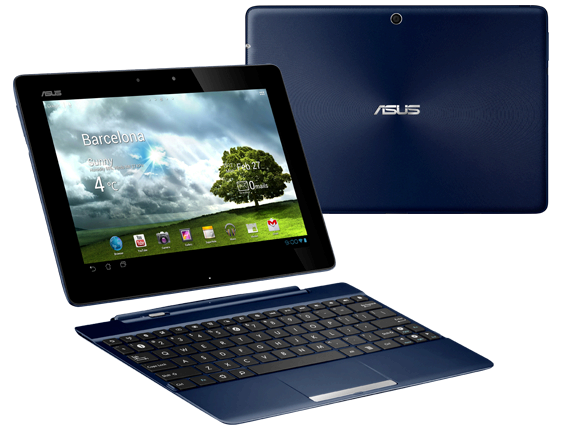
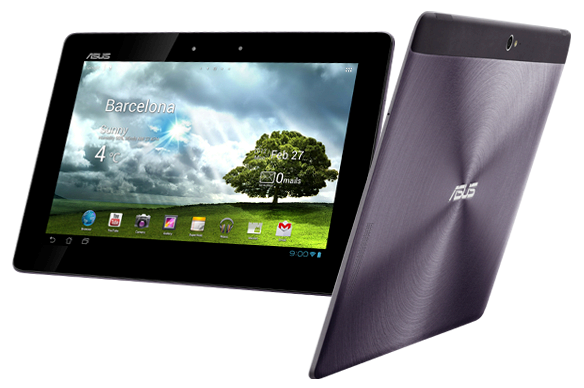
The Transformer Pad 300 looks like a slightly lower-end version of the existing Transformer Prime. Like the TF201, the TF300 has a quad-core NVIDIA Tegra 3 CPU, 1GB RAM, 802.11b/g/b WiFi, and a 10.1″ 1280×800 display. However, the display is IPS, not Super IPS+, and it only has 16GB of storage – instead of 32GB or 64GB. The TF300 has Bluetooth 3.0, up from 2.1+EDR. The TF300 loses the flash on the rear camera, though it is still 8MP, with a 1.2MP front camera.

While the TF201 is only available with WiFi, the TF300 will also come in HSPA+ & LTE versions. Battery life is 10 hours, 15 with the dock – down from 12/18 on the TF201. And it is physically slightly larger.

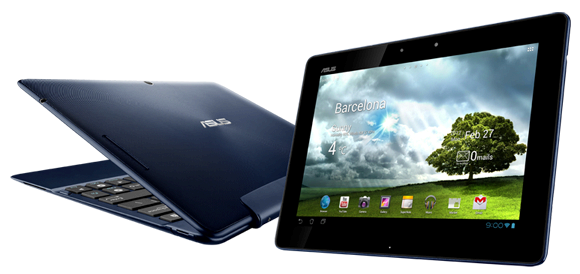
The other model, the Transformer Pad Infinity, goes the other way – an upgrade on the Transformer Prime. We saw this model teased at CES as a new model of Transformer Prime, the TF700. Specs-wise it is clearly an updated version of the Transformer Prime. It is the same size and weight – the keyboard dock is actually the same unit.

The WiFi model has the same 802.11b/g/n and BlueTooth 2.1+EDR, 1GB RAM, 32/64GB storage, and the NVIDIA Tegra 3 quad-core CPU – only here is is clocked up to 1.6GHz. The like the TF201 the screen is a 10.1″ Super IPS+ display – but the resolution is 1920×1080 Full HD. It does as some new tweaks. In addition to Bluetooth 2.1+EDR it has Bluetooth 4.0 LE, or Low Energy.

Unlike the TF201, the TF700 will also come in HSPA+ and LTE models, which differ in other details. Instead of the NVIDIA Tegra 3 quad-core CPU, these units will use the Qualcomm MSM 8260A/8960 Snapdragon S4 Krait Dual-core clocked at 1.5Ghz. Why? When they started designing this unit the Tegra 3 wasn’t yet paired with 4G chipsets. It seems the TF300 was designed later, as there is no indication the cellular variants of that model will not be using the Tegra 3. Battery life is given as 10/16, which makes sense with the higher resolution screen and higher CPU clock.

I love my ASUS Transformer Prime, and the Transformer Pad Infinity looks interesting. I’d go with the WiFi model since I currently use my Prime with WiFi tethering on my G-Nex.

EDIT: ASUS just posted a video of the launch event at Mobile World Congress:

Posted in Android | Tagged , , , , , | 1 Comment

The Road Ahead For TiVo

TiVo Logo I mentioned my conversation last Friday with TiVo’s Public Relations Manager, Jessica Loebig, and VP & GM of Product Marketing, Jim Denney, in my posts on the transcoding box and the IP STB, but we discussed more than those two products. We also discussed plans for the next software update, future product plans, the loss of Blockbuster, and more. I can’t share everything we discussed – yet – but I can share some of it.

Starting with the next software update, 21.x, which is expected in the spring (late-April or early-May), there are a few things TiVo is willing to confirm. (I’ve touched on this release before.) Aside from general polish, more screens being moved into the HD UI, bug fixes – aka the usual – the biggest news is probably the long awaited update to two streaming clients: Netflix and YouTube.

The TiVo Netflix app is getting a complete overhaul – or, rather, a replacement. The new app is actually written by Netflix and integrated by TiVo, using TiVo’s Adobe Air-based SDK. It will provide a completely modern Netflix experience, on par with other devices. TiVo says it will be similar to the Netflix client found on the Insignia Connected TV with TiVo Design, but not exactly the same.

YouTube is also getting a new client, which will be radically different. The new client will implement the YouTube ‘lean back’ style interface, and is probably most similar to the version found on Google TV. YouTube created the ‘lean back’ UI especially for home entertainment implementations, where you ‘lean back’ as opposed to ‘leaning forward’ over your computer keyboard, so this should be a nice improvement.

I did ask about an update for the Amazon app, but it will not be part of the next update. TiVo recognizes there is demand for support of the free Amazon Prime streaming in Amazon Instant Video, but to implement it they need to work with Amazon. Currently they’re in “active discussions” with Amazon about the implementation, but they can’t yet say when it might happen. But know that it is on their radar. They did want to stress that the TiVo app does have access to the complete Amazon Instant Video library via downloads, it is only the streaming that is currently missing.

I also asked about Spotify support for the US. TiVo queried US customers about interest in Spotify last July, and the Virgin Media TiVo units in the UK got Spotify in November, but there is still no sign of it in the US. TiVo doesn’t have an official comment on this at this time, aside from acknowledging the interest. Personally I think it is on the road map but they’re not ready to talk about it yet.

Something else that is coming in the next release is parental controls in the HD UI. Until now customers who wanted to enable parental controls needed to switch to the SD UI, so this is likely a welcome change for parents. This did, unsurprisingly, spark a discussion on TiVo KidZone and the future thereof. At this time there are no plans to bring TiVo KidZone to the HD UI. There are ongoing discussions within TiVo about the future of KidZone in general, and what form it might take, if it remains at all.

I got the impression that KidZone was never a high demand item and the justification for devoting the engineering resources needed to bring it to the HD UI is difficult to make. We may see fancier parental controls instead of a special KidZone implementation. Or perhaps it is something that might be addressed via user-based folders (which we’ve seen teased in screen grabs in the past), by tying access to folders to the parental controls and only allowing the kids access to their own folder. But that’s just speculation on my part.

Looking further out I tried to get some info on the new SDK, but they’re not ready to discuss that just yet. They did confirm that it is Adobe Air with ActionScript 3.0 (at least for the initial release, it seems like other environments may be added in the future), and they are very serious about supporting developers. They’ve hired someone for a new position tied to the SDK, so it will have dedicated attention. I’m hoping it fares better than the old public HME SDK. This time around I think TiVo has more appreciation for the importance of third party apps.

We also discussed Jason Wong’s interview at last September’s IBC show. I’ve already covered the transcoder box and IP STB in previous posts. The other big item, to me at least, that Jason mentioned was DLNA support:“Yes, using DLNA and DLNA approved DRM like DTCP, but yes.” This sparked an interesting discussion. First of all, TiVo clarified that Jason’s comments were within the context of the European audience of the IBC show. European units support DTCP but not the entire DLNA standard.

The discussion was over whether it makes sense for TiVo to support DLNA on the US units. My stance is that yes, it does – especially as a DLNA client. While it would be nice to have TiVo as a DLNA server, I actually don’t see it being as useful for most users. There aren’t currently a lot of devices that would act as a DLNA client for a DTCP-IP protected stream. Down the road a bit I think this will be more useful, as more cable MSOs implement this tech, thereby driving more consumer devices (like smart TVs) to implement the client side.

But going back to my original point, I think it would be useful for TiVo to implement DLNA client capabilities. Right now getting media onto a TiVo from local sources is a bit of a pain in the ass. You have to install TiVo Desktop, or one of the third party tools like kmttg, Streambaby, or pyTiVo, just to get your music, photos, and/or video onto the TiVo for display. But many devices already have built in DLNA server support and it would be plug-and-play if TiVo would only connect to these existing servers.

To me a huge issue is that so many modern smartphones have built in DLNA support. Any of the content you have on your DLNA-enabled smartphone could be streamed wirelessly over the local network to a DLNA-enabled TiVo. No need for HDMI or MHL cables, or docks, etc. Just connect to the local LAN and away you go. This is possible with most connected TVs, but that’s still a small market. TiVo could be the gateway for this content for many consumers; I think that would be very useful. Not to mention making it easier to display content from your PC, NAS, etc.

I think we had a good discussion about DLNA support and I’m hopeful TiVo will give some serious thought toward implementing it, at least as a client to start. But they are interested in gauging the demand from the market in general, so how about it? Is DLNA support, client and/or server, something you’d like to see TiVo add? And why?

Posted in Amazon, Amazon Unbox, Broadband, DVR, NetFlix, Software, TiVo | Tagged , , , , , , , , , , , | 13 Comments

TiVo To Launch IP-Only STB This Summer

TiVo Logo During Thursday’s financial call, TiVo President & CEO Tom Rogers surprised a number of people when he said:“By the end of the summer we’ll further that lead with the addition of an IP-based set top box.”

But this really wasn’t a surprise; it was mentioned before – by TiVo’s Director Product Marketing, Jason Wong. Quoting my earlier post:

He mentions “a couple of thin-client zapper boxes, with or without a tuner”, which is interesting, since the existing TiVo Preview does have a tuner and CableCARD slot. Perhaps TiVo is working on a more Roku-like streaming-only device? He does mention it again later, referring to it as a ‘thin-client’.

Later in the financial call, during the Q&A, Roger’s expanded upon the IP-based STB, saying:

It is a way for multiple sets in a household to be served. It works with a core unit, called a gateway unit, that allows for multiple streams to multiple television sets as part of a whole-home solution. It is something that we will be delivering to a number of operators who are looking for it in the middle of the year, so I’m not going to be precise with respect to which quarter we deliver it in. But it is an important part of our whole-home, multi-device set of solutions. We have a non-DVR set top today that we are deploying for operators who want to make sure that they have a cheaper multi-set solution so that they can have a non-DVR set top working out there, but this is a way to bring down cap-ex expense even further. And ultimately is a complement to the core TiVo unit.

The “current non-DVR set top” would be the TiVo Preview, so this unit is clearly a new box. And the lower cost reflects the removal of the tuner hardware. But note the bit about “deploying for operators”. Like the TiVo Preview, this unit is, initially at least, targeted at TiVo’s MSO customers – not retail.

This is also a product I discussed last Friday with TiVo’s Public Relations Manager, Jessica Loebig, and VP and GM of Product Marketing, Jim Denney, along with the transcoder box. They couldn’t provide too many details on the IP STB, but the gist is that this will be an IP-only, tuner-less streaming box. It is not a retail version of the TiVo Preview, as that unit has a CableCARD tuner. Rather, this would be an even ‘thinner’ thin client, which relies entirely on the network for content. My understanding is that, like the Preview, it would access OTT content directly from the Internet, as well as streaming content from a TiVo Premiere DVR within the home.

Live TV would also utilize a tuner from the central TiVo Premiere, there being no local tuner and all. That’s what I was hinting at in my transcoder box post when I said “As well as for another application that’s coming, but I’ll leave that for another post.”.

If TiVo could deliver this at a low enough price point, I think it could be an interesting entrant into the streaming STB market. TiVo would clearly need to beef up their third party content offerings to compete with the likes of Roku, Google TV, and Boxee, but that’s not out of reach if they promote their new SDK effectively. And TiVo’s MSO market offers a unique attraction for developers looking to address that market. If they offered this unit at retail it could leverage apps developed for the MSO market, and vice-versa.

But first TiVo would have to offer this at retail. I discussed this with Jessica & Jim, and they recognize that there is demand for such a product, and acknowledged that it’d certainly be a perfect companion for the Premiere Elite. But for now TiVo doesn’t have any plans to bring the TiVo Preview to retail. Currently they seem focused on polishing the products in the MSO market, which may not be a bad approach – as frustrating as it may be as a consumer who desperately wants one.

In the MSO market they have the MSO to support the customer and work out any issues. If they can improve the product in the MSO market, when they do finally bring it to retail it should be much more polished. The major concern seems to be the user experience, and potential network issues. MSOs deploying the TiVo Preview are insisting on MoCA or wired Ethernet with minimum performance for the installation. In the retail market you’d be much more likely to have people using iffy network connections – weak wireless or powerline connections, etc. And they’re more likely to blame TiVo if the product doesn’t work well than to recognize a network issue.

Personally I think TiVo could take an approach similar to what they planned for the Premiere Elite. Such as“vigorous customer and retailer education efforts designed to ensure that consumers recognize the capabilities” of the new box, and marketing the streaming box“primarily through its custom install, high-end retail, and TiVo.com channels” where they can better educate the customer on the requirements for successful utilization.

My impression is that TiVo is certainly aware of the retail demand for such a unit, and they’re constantly evaluating it, but they’re not yet ready to launch. But they probably will a little further down the road.

Oh, and going back to the SDK, I asked about that on our call last Friday as well. Right now TiVo doesn’t have much to say other than “stay tuned”, and to confirm that the new SDK environment is Adobe AIR with ActionScript 3.0, but they hint at other environments in the future.

Posted in Broadband, DVR, TiVo | Tagged , , , , | 4 Comments

Blockbuster On Demand Abruptly Pulled From TiVo And Other Platforms

Blockbuster Logo Last Thursday, just after returning from my honeymoon, I received this as a tip from a reader, William:

Dear William,

We have some good news and some bad news. The bad news is that, as of 3/31/12, the Blockbuster app will no longer be available on your TiVo DVR. We are updating our technology platform and will not be able to continue supporting your device.

You won’t be able to watch movies from Blockbuster On Demand on your device, but you can still watch on any of our other devices or stream via PC or Mac. See a list of supported devices.

Your friends at Blockbuster

I spoke to TiVo on Friday, and they basically found out about this along with the rest of the world – the day before. Neither Blockbuster, nor parent Dish Network, had notified TiVo that this was coming. TiVo had just started discussions with Blockbuster after hearing the news, and those are still ongoing. TiVo says they’ll make a statement on this once they have something concrete to say.

The reason for this really has nothing to do with TiVo, or any of the other similarly impacted platforms that are losing Blockbuster. This all started back in 2007 when Blockbuster attempted to enter the digital movie market by acquiring Movielink. This attempt failed, so in 2009 they decided to try again by partnering with CinemaNow, which had just been acquired by Sonic. Ever since then Blockbuster’s download service has been powered by Sonic, which has since been acquired by Rovi.

Blockbuster’s deal with Sonic expires on 3/31/12, and they aren’t extending it. Since all of the current platforms that support Blockbuster’s download service use the Sonic implementation, they’re all going to stop working – and that includes TiVo.

While most Blockbuster On Demand products have been using the download service, for a while now Blockbuster has also had a streaming service. It is used primarily to support mobile devices and computers, although Samsung has been supporting it on some of their recent home entertainment products as well. It looks like Blockbuster is phasing out the download service completely, in favor of going streaming only.

This streaming service also provides hope for Blockbuster On Demand’s return to TiVo and other platforms. Samsung has already shown that home entertainment devices can support the service, and I suspect there is no technical barrier to bringing it to devices such as TiVo. However, presuming the business side of things is addressed, it will still require all new development to implement the streaming client for each platform. Given the time needed for development, and then testing, I wouldn’t expect to see anything in the near future.

Also, the streaming service isn’t going to support older hardware that can’t handle new codecs. That means, just like Netflix, Hulu Plus, YouTube, etc., it will never hit the older TiVo Series2 platforms. And while technical reasons will keep it off of the Series2, I expect business reasons will keep it off of the Series3 as well. Any new client development will almost certainly be done in Adobe Air in the new SDK, just as with Hulu Plus. This will only run on the new Series 4/Premiere hardware. Since the Series3 line is no longer produced and sold, there is really no justification for investing resources in developing an HME-based client just for that platform.

So Blockbuster On Demand is going away, but it may be back at some point – as a streaming app on the Premiere.

Posted in Broadband, TiVo | Tagged , , , , , | 2 Comments