Automate TiVoToGo Downloads, Decryption, And Commercial Removal

Lifehacker has an article today about a TiVo tool called KMTTG. KMTTG, which apparently stands for Kevin Moye (the author) TiVoToGo, is a Perl/Tk program that… well, I’ll let Kevin explain it:

kmttg is a Perl/Tk program I wrote to facilitate TivoToGo (TTG) transfers that can download, create metadata, decrypt, run comskip & comcut (commercial detection and removal) and re-encode multiple shows you select from your Tivos all in 1 step. The program also has the capability to transfer and process shows automatically from your Tivos based on titles and keywords you setup.

In slightly less geeky speak that means kmttg can download content from your TiVo via TiVoToGo. Parse out the program information and description, the metadata, and save it. Decrypt the TiVoToGo .tivo file into a standard MPEG-2 file. Run an application called ‘comskip’ which analyzes the video and marks where it believes the commercial breaks are. Then call ‘comcut’ which takes the information comskip provided and removes the commercial breaks from the video. And finally it can then take that video and transcode it into other formats, such as H.264 for your portable device.

Now, it doesn’t do all of this itself. In fact kmttg is really a wrapper of scripts written in Perl with a user interface written in Tk which automates and abstracts several other applications such as curl, TiVoDecode, mencoder, ffmpeg, comskip, etc. So you could do all of these steps manually and individually, but kmttg makes it much simpler and easier.

Installing and using kmttg is probably not for the technophobe. You need to have Perl and Tk installed on your system, and neither is standard on Windows. You’ll need to install a Perl distribution, such as ActiveState ActivePerl, and possible manually install Tk as well. kmttg is available for Windows and Linux, though since it is Perl and the prerequisites, or their equivalents, exist for Mac I bet a technically savvy Mac user could produce a working Mac version as well. Going by the kmttg discussion thread at TiVoCommunity, it looks like it has been tried.

kmttg looks like a nice tool for those who want to extract video from their TiVo and use it elsewhere. It is a free alternative to TiVo Desktop Plus on Windows, and it has features like commercial removal which TDP lacks.

If you have, or know of, a TiVo-related application I’ve missed, let me know.

Posted in PC, TiVo | Tagged , , , , , | Leave a comment

TiVo Stymied By HD In Canada

TiVo has had a long and troubled history in Canada. It was three years ago, way back in September of 2005 that TiVo extended their service into Canada, but they still didn’t officially sell units there. Users could buy units from the US and import them into Canada, but it was clearly limited support. It wasn’t until less that a year ago, in November, 2007, that TiVo became available at retail in Canada. Less than two weeks later TiVo was reported to be selling ‘extremely well’ in Canada. In March of this year TiVo was making a concerted marketing push in Canada, including in-store demonstrations.

Apparently the honeymoon didn’t last long. The ‘extreme’ sales were almost certainly due to years of pent up demand and, coupled with the rise of high-definitely, CBC News is reporting that TiVo is struggling in Canada. Unlike the US, where the FCC has mandated CableCARD for open access to digital cable, Canada has no such requirement. Like satellite in the US, cable in Canada is a closed system. If you want digital cable, including HD content, you have to use a cable company provided set-top box. In other countries, like Australia, over-the-air broadcasts still rule and digital broadcasting is actually increasing the use, but like the US in Canada cable dominates the market.

TiVo is currently selling the Series2DT in Canada, their only remaining unit that works with an external cable box. But the S2DT is limited to SD content only. And it is only dual-tuner for analog cable channels, for any digital channels it needs the external STB and it is limited to just one channel. This puts it at a disadvantage to the cable company DVRs which are dual-tuner and handle digital HD content on both. Without access to HD content, TiVo’s future in Canada will look increasingly bleak.

So what’s can TiVo do? Well, there are a couple of main options. The first is to do a deal with Canadian cable MSOs, such as Rogers Communications or Shaw Communications, similar to the deals with Comcast and Cox in the US. TiVo’s STB software could be deployed on Canadian cable STBs. Or such partnerships could see a version of the TiVo HD with built-in cable access (in place of CableCARD) distributed through the MSO as an alternative to the cable STB. That would be similar to the custom TiVo HD-based unit for Australia’s Seven Network. The issue here, of course, is getting such deals in place. It isn’t a technical issue but rather a business issue. And it isn’t clear that such deals would come together.

The other alternative is a technical solution, find a way to access the HD content from the system as it stands today. And the only real solution there would be to capture it from the HD component output on the cable box. Until fairly recently this was not feasible on a cost basis. The technology for HD component capture has existing for a while, but it is only now coming down to consumer price points. I reported from CES in January on the first wave of component input DVRs.

Hauppauge’s HD PVR USB add-on for PCs is one such example, but it is $249 for just a basic capture & encoding unit, the PC is doing most of the work. The Slingbox PRO-HD is another new device which can capture HD video and encode it on the fly, but it is similarly priced at $299.99. Now, those are retail prices, so the actual cost of the components to add such support is much less, but that’s just one input. To compete with dual-tuner DVRs TiVo would really need to add two HD input and encoder chains to the unit.

And it isn’t as elegant a solution while being more expensive. Not only would the TiVo cost more, but instead of one clean box you’d have the TiVo, one or two cable STBs, and the associated cabling and IR blasters. And if you had two STBs, to enable dual-tuner recording, you’d also have to contend with IR signal cross-talk to make sure signals meant for one STB aren’t ‘seen’ by the other. Still, as I noted in my TiVo HD review, it looks like TiVo may have considered at least one set of inputs for the TiVo HD. But those were probably not meant to be HD.

Perhaps TiVo could build a Hauppauge-like external USB capture box to connect to a TiVo HD via the USB ports. Such a dongle could be useful in general for other users as well, such as those using satellite but still wanting to use TiVo for HD content. Or users of cable systems which still don’t support CableCARD (some small operators have waivers). But the real question is if the market for such a solution, more expensive and less elegant as it is, is large enough to justify the costs in producing it. It is absolutely technologically feasible, but is it economically feasible? I’m not so sure it is.

There is a third option, but it seems even more remote. TiVo could convince Canadian regulators to impose open-access rules on Canadian MSOs, as the FCC has in the US. That could take the form of CableCARD (perhaps the simplest solution as it exists and is deployable today, warts and all) or some other solution such as DCAS. But passing new regulations tends to be a very slow process with little certainty.

I think, clearly, the best solution for both TiVo and the users would be a deal with the MSOs to bring the TiVo service to them at an affordable rate without lots of extra dongles and cables.

In any case right now TiVo’s future in Canada is hazy at best. As the Magic 8 Ball says – Answer unclear, ask again later.


Posted in TiVo | Tagged , , , , | 2 Comments

Western Digital 500GB eSATA My DVR Expander $131.99 At Buy.com

Buy.com has the Western Digital 500GB eSATA My DVR Expander on sale again for $131.99. This is the only drive officially approved for use with the TiVo Series3, TiVo HD, and TiVo HD XL. That’s a great price on that drive, so if you’ve been thinking about getting one, now is a good time.

Posted in TiVo | Tagged , , , , , , , | 1 Comment

Teleworld Paid Program Showing Up In TiVo Now Playing List

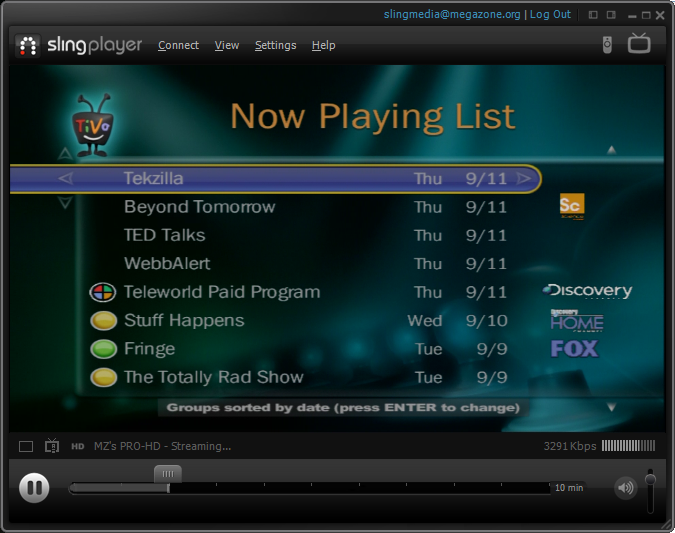
Teleworld Paid Program in TiVo Now Playing List

TiVo users, including myself, were surprised to find a recording in their Now Playing List called ‘Teleworld Paid Program’, with four color icon that hasn’t been seen before. See the screen capture above, and click on it for a larger version. (Yes, that’s my TiVo captured via SlingPlayer.) Some people were upset by this, wondering why their TiVo was recording paid programming. Others were just baffled by it.

So, first of all, what is the Teleworld Paid Program? You know the videos used in Showcases, promotions, interactive ads, etc, on the TiVo? Teleworld Paid Program is how TiVo gets those video clips on the box. TiVo buys several broadcast slots a week on various cable channels and broadcasts this special program. If you watch one of these you’ll see it is made up of short segments one after another. The broadcast contains flags to mark the segments, and the TiVo slices and dices the signal recording into the multiple bits and links them to the proper item on the TiVo.

As for the name, TiVo was originally named Teleworld when the company was founded. They changed the name to TiVo later. I guess using it for this is a little nod to the early days. Teleworld Paid Program has been around for many years, but most users never become aware of it.

So why is it showing up in the Now Playing List now? Well, clearly something went wrong. The broadcast was recorded as it normally is, but it wasn’t hidden from the user as it is supposed to be. The new icon must be something TiVo had in the system for their special broadcasts, probably to help engineers recognize them. (There used to be a back door whereby you could make the hidden recordings show up in the NPL, I bet it is still in there for developers.)

So, in short, this looks like a glitch. I’m sure TiVo will work to correct this. It isn’t some bizarre new way to push advertising on the users, and users shouldn’t waste their time trying to figure out why it recorded or try to prevent it. Just delete them and give TiVo a little time to fix the issue.


UPDATE: TiVoPony has confirmed that it was a glitch:

Hey guys, we’re very much aware of this and it was just a one time glitch. Very sorry about it, you may delete that recording!

The team is off now to tweak the processes in place so that this doesn’t happen again.

Posted in TiVo | Tagged , , | 6 Comments

TiVo News: Season Premiere Guru Guide. Get it while it’s hot!

TiVo’s latest newsletter…
Continue reading

Posted in TiVo | Tagged , | Leave a comment