Flight testing continues on the Lockheed Martin F-35 Lightning II, and along with flight testing comes the videos LockMart keeps pumping out to tout the progress. It is all part of their marketing effort to maintain a favorable view of the project, I’m sure – but they’re still nice to watch. First up is a night refueling of an F-35A:
And second is a high speed fly-by by the F-35C:
I love the condensation that forms around the fuselage due to the pressure differentials.
Boeing is all about getting high on nature. I’m talking about aviation biofuels, of course – what else could I be talking about? They’ve released this video highlighting their efforts in the area.
Flying cars have been capturing the popular imagination for decades, but none of the attempts have every proven to be practical, or at least not commercial successes. A couple of well known examples of past attempts are the Fulton Airphibian, the ConVairCar, but the most well known is probably the Aerocar. The most infamous of them all is the Moller Skycar, which has been vaporware for four decades. None of them succeeded – but it hasn’t stopped people from continuing to dream and to look for new ways to tackle the problem.
Solutions mainly fall into two categories – flying cars and roadable aircraft. A flying car is a car first and an aircraft second. It is meant to be driven regularly and occasionally flown. Since the design will always be a compromise flying cars favor the car side of the equation. Roadable aircraft are just the opposite, of course. They’re aircraft first and cars second. They are not meant to be driving on a regular basis. Rather the ability to drive on public roads is really for convenience, and the main function is flight. You’d normally only drive such a vehicle from your home to the airfield for departure. Then, upon arrival at your destination, you’d be able to drive off the airfield to where you need to go.
The real advantage is not having to have a place to park your plane at the local airfield – you can drive it home and keep it in your garage. You don’t need to leave a car at the airport when you go on trips, or take a cab or car service there. And the same at the destination, you can take a trip and drive to your business meeting, hotel, etc. No need to book a car or take a cab. And if inclement weather grounds you, you can drive as a backup plan rather than having to cancel your trip. And once you’re through the bad weather you can go to the nearest airfield and take off again. But the compromise on these vehicles really leans toward the aircraft side, so they’re not meant to be your daily driver.
It is this compromise, in either direction, that has long been the Achilles heel of such designs. Aircraft need to be strong and light, and have weight and balance requirements to be able to fly properly. Cars on the other hand tend to be heavy and rugged to withstand the abuse of bumps and potholes, not to mention all of the crash worthiness features which add a lot of weight. But newer materials, such as composites, are opening up possibilities for strong yet light designs which can meet automotive crash standards yet still allow for flight.
The best known current effort is actually a roadable aircraft, the Terrafugia Transition. Or, as they like to call it, a “Street-Legal Airplane”. There’s no hiding what it is; when it ‘car mode’ you can still clearly tell it is an aircraft. The production model prototype just made its first flight on March 23rd, 2012 and they released this video:
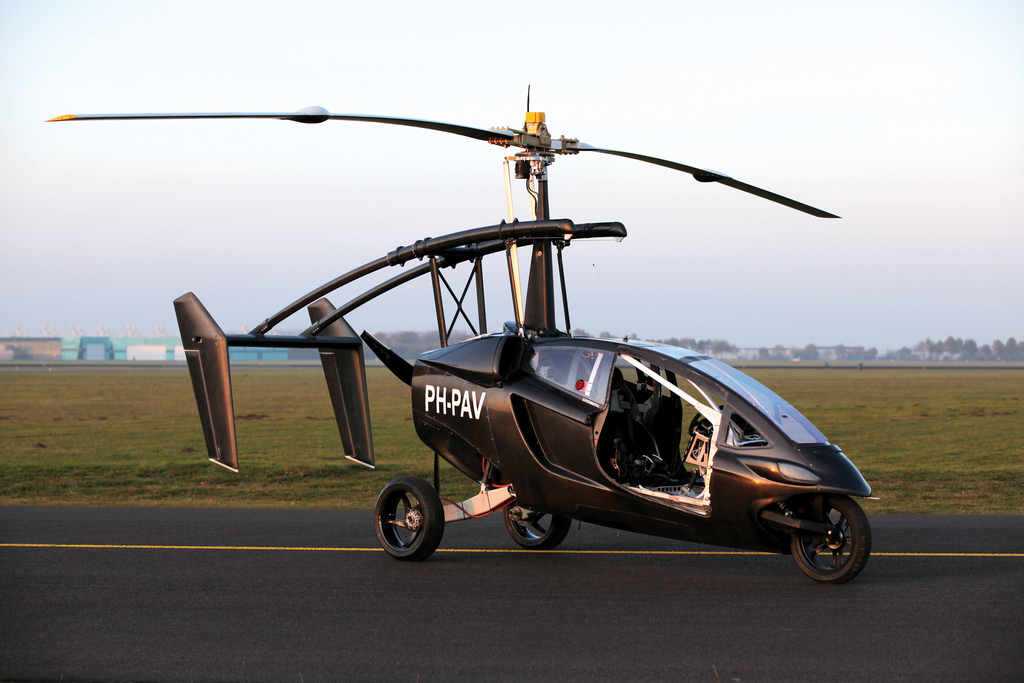
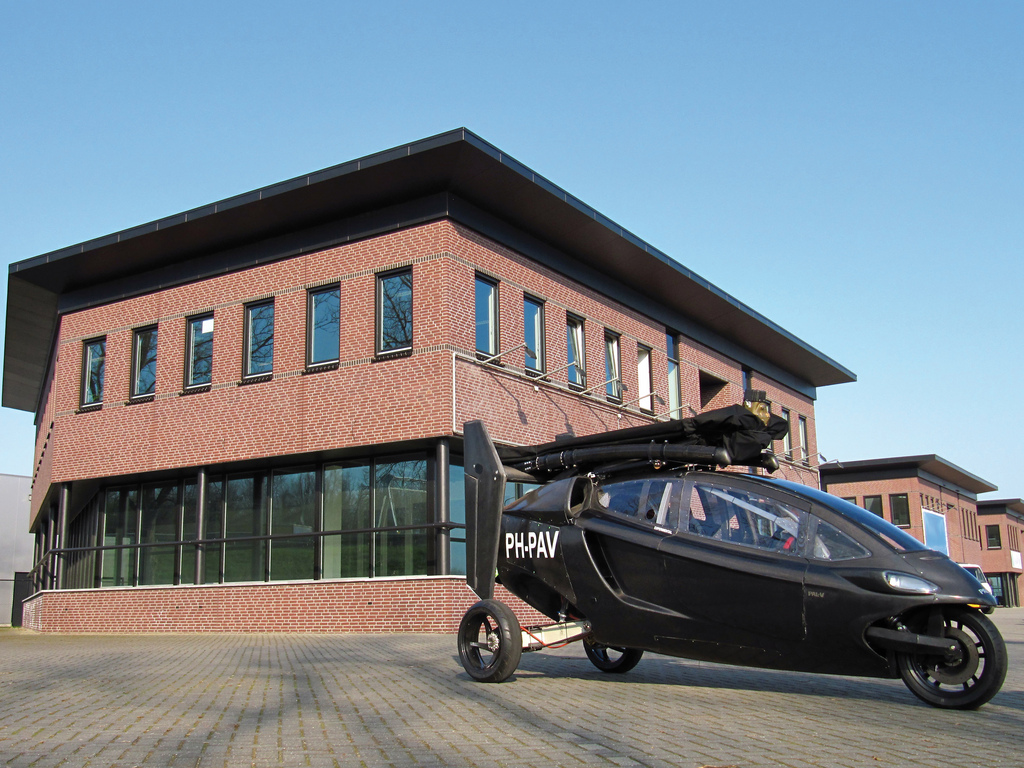
The Transition is certainly a major achievement, and it has a shot at market success, but I think another new vehicle is more interesting. The PAL-V ONE, or Personal Air and Land Vehicle, is more of a true flying car. Well, actually, as a three wheeler it would be a flying motorcycle in the US. (That varies country to country.) There is a flying prototype and it is much less obvious in car mode that it is a flying machine. One reason for that is that, unlike the Transition, which is a fixed-wing aircraft, the PAL-V ONE is rotary-wing craft – an autogyro, or gyroplane, to be precise. Note that it is not a helicopter – there is a difference.
The rotor blades are much smaller than a fixed wing, which means they’re easier to stow and hide. And the PAL-V ONE has a pretty clever layout with the tail surfaces telescoping over the body, with the rotors folded back. The prototype is a little rough, but the renders of the intended final design look like they plan to clean things up a bit for production.
I rather like the Dutch government’s concept of building small takeoff and landing sites alongside highways. Because of the autogyro’s ability to takeoff and land in very short distances they’d only need to be about 100 meters long. The concept looks much like a rest area or scenic overlook alongside US highways.
The three wheel leaning design immediately brings to mind the old General Motors Lean Machine that I used to see at GM’s World of Motion at Walt Disney World’s Epcot Center before it was remodeled. I always wanted one:
Though the design is really closer to that of the Carver One, which is no coincidence and the PAL-V One licenses the Dynamic Vehicle Control (DVC) technology developed for the Carver One as the basis for it’s tilting system when driving:
Though you can clearly see the PAL-V ONE uses a different implementation. Whereas the Carver One’s rear wheels always remain perpendicular to the ground and the power system is kept fixed and level, the PAL-V ONE uses an independent rear suspension that allows each rear wheel to flex independently and lean into the turn, and the engine is contained within the leaning unibody design.
I would love to have one of these, it’d give me a reason to dust off the private pilot’s license I haven’t used since the early 90s (of course I’d have to get autogyro training), but the price is expected to be around $300,000. That’s just a smidgen more than I paid for my house, so that’s probably not going to happen. Still I’d love to see it succeed, even if I can’t afford one.
Building on the runaway success of their TiVo deployment in the UK, Virgin Media has revamped their service ‘bundles’ into three new ‘Collections’, all of which feature TiVo as standard. At this point if you sign up for service with Virgin Media it pretty much means you’ll be getting a TiVo.
Talk Weekends unlimited phone calls (Unlimited weekend calls to landlines starting 01, 02 03, plus 0870 numbers and Virgin Mobile phones.)
£25 per month
Premiere Collection:
500GB TiVo
TV: XL 175 channels including 23 HD
60Mbps broadband
7000 hours of TV on demand
Free additional V HD box included for another room
Talk Weekends unlimited phone calls (Unlimited weekend calls to landlines starting 01, 02 03, plus 0870 numbers and Virgin Mobile phones.)
Included Extras: 3 months of Spotify, access to ESPN/ESPN HD
£45 per month
VIP Collection:
1TB TiVo
TV: XL 175 channels including 36 HD (counting 13 HD channels for Sky Premiums) as well as Sky Sports 1-4, Sky Sports F1 and Sky Movies
100Mbps broadband (increasing to 120Mbps soon)
7000 hours of TV on demand
Free additional V HD box included for another room
Talk Anytime unlimited phone calls (unlimited evening and weekend calls. Cheaper mobile and international calls)
Included Extras: 3 months of Spotify, access to ESPN/ESPN HD, Sky Sports & Movies collection, HD fee for Sky Premiums, Talk Plan extras (Mobile/ International/08)
£90 per month
Of course, there is fine print:
All prices are when taken with a Virgin Home Phone line at £13.90 per month, e-billing and with payment via Direct Debit. All Virgin Home Phone services include unlimited calls to UK voice landlines, 0870 numbers and Virgin Mobiles during inclusive talk periods. All Virgin Broadband services come complete with SuperHub dual-band wireless ‘n’ router and a free security suite featuring Parental Controls for the lifetime of a customer’s broadband subscription. All Virgin TV services come with access to Catch Up TV (featuring BBC iPlayer, ITV Net Player, 4OD, Demand Five and Sky Anytime on Virgin Media), Virgin TV on Demand, and basic HD at no extra cost (£7 fee payable for Sky Premiums in HD). Installation fee of £49.95 applies. Standard contract terms 12m for new or existing customers. 6m Half Price offer only available to new customers taking a Collection on an 18m contract. Subject to change.
To promote these new Collections Virgin Media is creating new ads featuring VM CEO, and Bond-villain-in-waiting, Richard Branson and star of stage and screen David Tennant. David is best known as the Tenth Doctor, the 10th regeneration of the titular character in the BBC’s Doctor Who. That actually caused a bit of a spat in the UK between the BBC and Virgin Media. See, the BBC has some strict rules about any of their properties, such as Doctor Who, being used in marketing from any outside vendors. And the first ad created for Virgin Media featuring David Tennant had a time travel joke and a direct reference to David’s star turn in Doctor Who. That video was posted, then yanked, re-posted in an edited form, and has now apparently been yanked from Virgin’s YouTube Channels again. However, the Internet being the Internet, there are numerous copies of the original version of the video posted by other users – such as this one:
Two additional ads have since been released:
There is also a behind the scenes ‘making of’ video:
There is a video embedding in the Virgin Media Collections page, but for some reason they’ve decided to region restrict it so it isn’t playing for me here in the US. I don’t get that, it is a promotional video for their own products, why lock it down? But, of course, it has been ripped and uploaded to YouTube multiple times:
A long running staple of science fiction and cyberpunk stories is augmented reality. Some kind of glasses, contact lenses, or implants that give a character a layer of information on top of what their standard perceptions of the world around them. Common examples are facial recognition that call up the name of the person you’re looking at, and maybe some related information. Or map directions overlaid onto the world. Or translating signs into the user’s preferred language. Basically it is like having an aircraft HUD (Head Up Display) shrunk down for personal use.
We’ve seen a few real work examples of augmented reality, with varying degrees of success. The most common are smartphone applications, such as Layar, which can overlay information onto the world as seen through the phone’s camera. So you can hold up the phone and call up different information – like icons for restaurants around you, or information culled from various social media sites, etc. But you don’t want to walk around holding your cell phone up in front of you, awkwardly looking at the world through its screen.
Well, Google has unveiled one of their pie in the sky projects aimed at making augmented reality practical – Project Glass. And it isn’t just a concept, Google co-founder Sergey Brin has been spotted in public wearing an early working prototype. The initial concept appears to be a monocular display that is worn like a pair of glasses. A combiner optic sits in front of the eye with most of the hardware contained in the frames. The basic information is displayed such that is appears in the user’s field of view, but when not displaying anything the combiner should appear transparent. They’ve also talked about a version for those who wear prescription glasses, so they’re not left out.
It is very early days and who knows when or even if Google commercializes the technology. But it does seem like just a matter of time until we have something like this available. The real problem has been the size of the technology. Past efforts to create something similar have relied on bulky LCD displays, and generally required the glasses to be cabled into a separate battery and processing unit. Google is hoping to create something self-contained within Project Glass.
The promotional video they released with the announcement of the project gives us a, somewhat cheesy, look at what they’re hoping to accomplish:


 Flight testing continues on the Lockheed Martin F-35 Lightning II, and along with flight testing comes the videos LockMart keeps pumping out to tout the progress. It is all part of their marketing effort to maintain a favorable view of the project, I’m sure – but they’re still nice to watch. First up is a night refueling of an F-35A: