

 Amazon today launched three new Kindle models, the base Kindle, the Kindle Touch (also in 3G), and the Kindle Fire. The existing Kindle Keyboard (and 3G) and Kindle DX remain available for now. You can compare the different models by clicking on the image to the right.
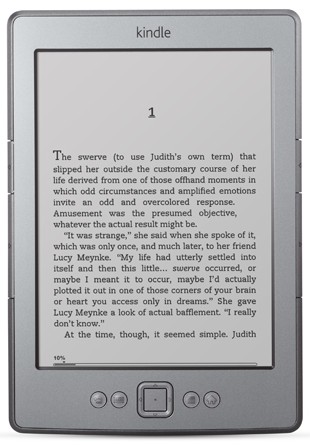 The base model, known simple as Kindle, has a 6″ 600×800 sixteen shades of grey E-Ink display with 2GB of memory, 1.25GB user available. It measures 6.5″ x 4.5″ x 0.34″ and weights 5.98 ounces. It has 802.11b/g/n networking and USB connectivity. It does not have 3G. It is 30% lighter and 18% smaller than the old model, but a lot of that savings comes from not having a keyboard. Text input requires using the D-pad and buttons to scroll around and on-screen keyboard and selecting one letter at a time. It is really a read-only device. It is available at two price points – “with special offers” (aka advertising) for $79.00 and without for $109.00.
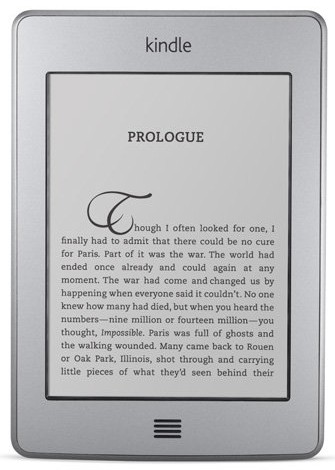 The Kindle Touch has the same 6″ 600×800 sixteen shades of grey E-Ink display, but, as you might have guessed from the name, it is a touch screen. As such the Kindle Touch does away with the D-Pad and buttons and relies on the screen for input.
The Kindle Touch also adds audio with built in speakers and a 3.5mm audio jack, which allows for music playback, audio books, and text-to-speech. It measures 6.8″ x 4.7″ x 0.40″ and weighs 7.5 ounces. Connectivity is via 802.11b/g/n and USB. Total storage is 4GB with 3GB user available. It is also available at two price points – $99.00 with special offers, and $139.00 without.
If you need connectivity on the go there is also the Kindle Touch 3G. It has all of the features of the Kindle Touch, with the addition of 3G support. It uses HSDPA, with a fall-back to EDGE/GPRS, on AT&T’s network in the US. It is slightly heavier at 7.8 ounces, but everything else is the same. It is slightly more expensive – $149.00 with special offers and $189.00 without.
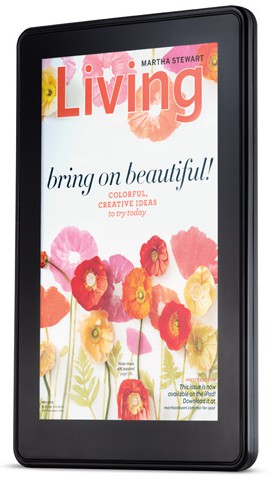 Of course the big story of the day, the one everyone was anticipating, is the release of Amazon’s new ‘Android Tablet’, the Kindle Fire. There has been a lot of speculation and hype about this, and a lot of high expectations – and a lot of people may be disappointed. This is not and iPad competitor, let alone an iPad killer. I wouldn’t even call this an Android Tablet, because that implies a lot that is not true about this device. This is not an Android tablet, this is a media access device closely linked with Amazon’s ecosystem, that just happens to be built on top of Android. It is not aimed at the iPad, it is aimed at the Barnes & Noble NOOKcolor.
As a generic Android tablet it would be fairly limited. It measures 7.5″ x 4.7″ x 0.45″ and weighs 14.6 ounces. It has a 1GHz dual-core CPU, an unknown amount of RAM, a 7″ 1024×600 color LCD touchscreen, only 8GB of storage that is not expandable (no microSD), and 802.11b/g/n. It has no cameras, no HDMI, no GPS, no 3G/4G, and no Bluetooth. And it is based Android 2.3 Gingerbread, not Android 3.0 Honeycomb. But, as I said, that’s not what this is. The user interface looks nothing like Android, it is a completely custom UI designed for Amazon’s services. There are no home screens, no widgets, no notification bar, nothing you’d expect from Android. Instead there is a ‘bookshelf’ interface that shows you books, media, and apps.
Yes, there are apps. There is no access to the Android Market, but, unsurprisingly, you can acquire apps from the Amazon App Store. It is all part of Amazon’s end to end integration. You buy your books from the Kindle Store, your music from Amazon’s MP3 store, and your videos from Amazon Instant Video. And yes, the free Amazon Prime streaming videos are supported. You only need 8GB of storage because you have unlimited storage in Amazon’s cloud for all content you acquire for Amazon – another way they encourage you to stay on the reservation.
If you want a tablet to use for productivity and general computing on the go, this is not the device for you. Buy a full fledged Android tablet and install the Amazon App Store, the Kindle App, the Amazon MP3 App, etc. You’ll have access to the same content, just not the integrated Amazon UI.
If you’re a heavy Amazon content user and you want a high-end portable media player that only costs $199.00, check out the Kindle Fire. It will be available November 15, 2011 and pre-orders are open now.
But do note that, while it bears the Kindle brand, it sacrifices most of the advantages of the other kindle devices. Since it uses a color LCD display instead of greyscale E-Ink battery life is measured in hours – 8 hours of reading or 7.5 hours of video – instead of the 1-2 months for the other devices. And it suffers from the same screen glare and washout issues as any other LCD device, so you won’t be able to view it in direct sunlight like the other Kindles. This is not your ‘read a book at the beach’ device.
The Kindle Fire looks like a great device, well designed for what it is. Just don’t expect it to be something it isn’t.
Along with the Kindle Fire, Amazon announced a new web browser, Amazon Silk. Silk is different from most other web browsers in that it has a split architecture. It lives on both the Kindle Fire and in Amazon’s Elastic Compute Cloud (EC2). Instead of directly pulling all of the content to the device and rendering it there, browsing requests go through the EC2. Content is pulled into the cloud and processed there before delivering and optimized result to the device. Since it is running through the cloud Amazon can also do clever things like cache commonly used content and even use aggregate behavior data to pre-fetch content it expects you to load next. If you’re looking at the front page of CNN they know which pages most users look at next and can pre-fetch that content to have it staged in the cloud for fast delivery.
Amazon is touting this as a new idea, but it isn’t really. Way back in the late 90s Palm used this kind of proxy pre-processing system to digest content for display on their early wireless devices, to accommodate their limitations. More recently Opera Turbo, the Skyfire browser, the Bolt browser, and probably others used similar systems to speed up page loading, provide Flash content to iOS devices, etc. But Amazon’s Silk benefits from their massive EC2 infrastructure, and their likely-to-be-huge user base which will provide them with the data they need for optimized caching and pre-fetching.
The existing Kindle models have also been repriced – the Kindle Keyboard is $99.00 with special offers and $139.00 without, the Kindle Keyboard 3G is $139.00 with and $189.00 without, and the Kindle DX (which has a 9.7″ screen and 3G) is $379.00.
The Amazon homepage announcement is below:
Continue reading