Today’s Woot! deal is on a refurbished current generation Apple 32GB iPod Touch with Retina Display & FaceTime for just $229.99 + $5 S&H. Full MSRP for a new unit is $299.99, and even Amazon sells them for $274.99. Do I really need to describe the iPod Touch to anyone reading this? If you don’t know what it is and what it does, you’re probably not someone interested in this deal in the first place.
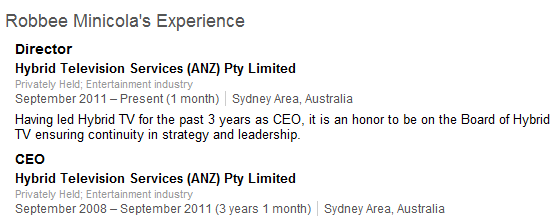
Robbee Minicola, whom I’ve mentioned a couple oftimes before, has served as the CEO of Hybrid TV Services (ANZ) – until now. Hybrid TV is the licensor of TiVo for Australia and New Zealand, the sole TiVo provider for those territories. According to her LinkedIn profile, as of September 2011 she is no longer CEO but rather is now serving on the Board of Directors, as a Director. I was alerted to this last night by a tweet she sent, stating that her next challenge would be re-adjusting to life in the states after 27 years of living abroad. I figured that meant a career change, so I checked her LinkedIn profile and caught the change.
Now, Hybrid TV Services has had a bit of a rough time. After their primary backer, Seven Network, declined to invest more in the company, and sales didn’t meet initial expectations (despite being the top selling DVR platform in ANZ), Hybrid was forced to lay off a large portion of their staff. But they remain the best selling DVR platform in ANZ and seem to be making slow but steady progress in building their customer base. I don’t think a change in CEOs is any kind of bad omen, especially as Minicola isn’t jumping ship, she’s still involved via the BoD.
We don’t know what triggered the move, but seeing as she’s not just leaving the CEO position but is leaving a country she’s lived in for nearly three decades to return to the US, I suspect there are reasons outside of anything to do with Hybrid TV Services and TiVo. She’s originally from the US, it could be personal reasons such as a family issue that led her to decide to return to the US, and that move necessitated stepping down. Who knows? The point is that it could be any one of a number of reasons and we shouldn’t read too much into it.
However, techAU seems to feel it is a terrible sign, as they covered the change with an article entitled“Head of TiVo Australia leaves for the US, future looks grim“. It includes statements such as“As an owner and fan of TiVo, its incredibly frustrating that TiVo is being left to die like this. There has now been multiple models and updates released internationally that have not made it to Australia.”, which I think is just a tad melodramatic. Left to die? Really?
Yes, TiVo in ANZ is based on the TiVo HD Series3 platform, as is the software, but so what? The hardware is unique to ANZ, designed to support only DVB-T. The services it supports are unique to ANZ as well, such as CASPA. The TiVo Premiere Series4 platform wouldn’t offer all that much of an advantage in that unique service environment. Broadband costs are high so there aren’t many OTT options, and unless you’re using a pay TV service you’re basically limited to OTA DVB-T aka Freeview, as TiVo uses. It would be a major investment to design a new ANZ box based on the Series4 platform and to put it into production and I’m not sure Hybrid could justify the expense when the return is questionable and funds are already tight. The current platform is already a leader in the local market, and that’s really what is important. You design a product based on what is appropriate for the target market, not based on what is done for other, very different markets.
Rumors of Hybrid’s imminent demise have been running since last year, so I find it hard to put too much weight on them without new evidence. Robbee Minicola is no longer the CEO, yes that’s a major change, but it isn’t a sign of the end times. Stay calm. I wish Robbee the best in whatever she has planned next, and I wish the best for Hybrid TiVo Services and the TiVo customers in ANZ. I hope the service continues to grow and becomes successful and sustainable.
EDIT: As some of you know, I cross-post TiVo-related entries from this blog to the TiVoLovers LiveJournal Community, including this one. It seems the cross post tripped one of Robbee’s alerts and she (or someone claiming to be her at any rate) posted the following comment:
Hey zonereyrie
Thanks so much for your kind words and correctly assuming all is good with Hybrid and I simply wanted to head back to the US. Yes the reasons are mostly family, but I am looking forward to being at the pointy end of things in Silicon Valley, LA and NYC.
It was an honor to be asked to go on the Board – and it is a great feeling to remain linked to the business and the customers.
I actually stuffed up on the tweet – meant to send it only to my linkedin connections but the darn twitter box was ticked and it went out to everyone!
Boeing last week officially launched a new generation of the venerable 737, the unfortunately named 737 MAX. Seriously, that’s what they’re calling it. As you might be able to tell, I’m not all that fond of the name.
The originally JT8D powered 737-100/200s with the long narrow ‘cigar tube’ nacelles are just 737s, or the 737-200 Advanced for later models. The first major revision was the switch to CFM56-3 high bypass turbofans, in the fat ‘hamster pouch’ nacelles. These 737-300/400/500 models retroactively became ’737 Classics’ when the next generation came out. That next generation is exactly that, the 737 Next Generation, or 737NG. This was a major redesign with a large number of design changes, and newer CFM56-7 engines, and it is produced in four models the 737-600/700/800/900.
Against newer Boeing names like the B787 Dreamliner or the B747-8 International, and lofty names of old like Stratocruiser and Stratoliner, ‘MAX’ just seems like a cold marketing name out of a focus group. And it plays right into the marketing message, which is that it offers “max efficiency, max reliability, max passenger appeal”.
But all I can think of is Pepsi MAX. Other options like B737NE (for New Engine) or B737RE (for Re-Engine) sound better to me. Or how about B737 LEAP, in light of the engine choice? Eh, maybe MAX will grow on me.
Anyway, naming aside, the B737 MAX is Boeing’s answer to the Airbus A320NEO, or New Engine Option. With today’s higher fuel costs, and stricter environmental regulations, airlines are looking for more efficient aircraft to reduce costs and emissions. Boeing had been pursuing a New Small Airplane, or NSA, with service entry around 2020. But Airbus launched the A320NEO as a minor update to the A320 family, with the largest change being new engine options – the CFMI LEAP-X1A or the P&W PW1100G Geared Turbofan (GTF). The NEO is expected to offer ~16% lower fuel burn and ~20% lower maintenance costs than today’s A320 family. The NEO has been a smash success in the market, with a large number of orders, so Boeing was forced to go with a more expedient solution of updating the B737, pushing the NSA out into the future. Most likely we won’t see a new single-aisle until the 2030 time frame now.
As Airbus is updating the A319/320/321 for NEO, but leaving behind the poor selling runt of the litter, the A318, so too is Boeing updating the 737-700/800/900, and dropping the 737-600. The new 737 MAX 7, 737 MAX 8, and 737 MAX 9 are based on the 737-700ER, 737-800, and 737-900ER, respectively. There will be as of yet unspecified aerodynamic improvements to boost efficiency, and the interior is getting a major overhaul with a new look based on the Boeing Sky Interior originally designed for the new B787. But, as with the A320NEO, the biggest change is in the engines.
While Airbus is offering a choice of two engines, Boeing has had great success with the sole-sourced CFMI CFM56 on the B737 Classic and NG, so the B737 MAX will be available with only the CFMI LEAP-X1B. The most visible difference on the new MAX line will likely be the chevron-edged nacelles, as seen in the photo, first introduced in the B787 and also found on the new B747-8. Boeing is claiming that the MAX will offer a 10-12% fuel burn improvement over today’s 737NG and a 16% improvement over today’s A320. Perhaps more importantly, they claim they’ll have a 4% fuel-burn advantage over the A320NEO.
Boeing has been making exclusive engine deals increasingly on newer models. The B737 has always been a single-option airliner. While earlier models of the B777 were available with engines from GE, Pratt & Whitney, or Rolls-Royce, later models are available only with GE90 powerplants. Similarly GE, P&W, and RR offered engines for earlier models of the B747, but the new B747-8 is available only with GEnx powerplants. The major exception is the new B787 which is available with GEnx or RR Trent 1000 power. It has been a good run for GE – they’re a major partner in the CFM International consortium, so they’re basically the sole provider for newer models of B737, B747 & B777, and the majority of B787 customers have specified GEnx.
(Historically this is somewhat ironic. P&W’s parent company is United Technologies. Way, way back, Boeing, United Technologies, and United Airlines were all part of one conglomerate. Vertical integration and all, until they were broken up. But these days Boeing works most closely with GE and P&W isn’t found on any of their latest models.)
I’m a little disappointed that we won’t be seeing a brand new jet in this category soon, at least not from Boeing or Airbus. The Chinese Comac C919 is on the way, but it won’t be anything radically new. And the Bombardier C-Series is a category down from the B737 & A320. It would’ve been nice to see something radical like a blended wing body or open rotor propulsion, but that’ll have to wait for the next generation it seems.
As a bit of a ‘bonus video’, this is how airlines shop for all the bits that go inside their fresh new airliner. Seats, entertainment systems, galleys, lavatories, etc. Well, it is how they shop for the B787 specifically, but this ‘one-stop shop’ approach is expected to spread.
While ONO has reportedly already started customer installations of TiVo in Spain, it looks like the official launch will be in October. Both reports can be true, it isn’t unusual for a vendor to do a ‘soft launch’ before an official launch to work out the kinks. TiVo will initially be available in Madrid and Barcelona, expanding into other ONO service areas later. As I previously reported, ONO’s TiVo will include apps for Telecinco, RTVE, TV3, Canal Cocina, Decasa, Sl Música, Hollywood Quiz, Ivoox, Picasa, and El Tiempo; it will also include games familiar to US TiVo users Skull and Bones, Word Smith and Same Game. I have to wonder if the games have been localized, though I’d really expect so.
Guillermo Mercader, Ono’s DG of residential services, says it will cost €10 a month, which confirms the earlier reports. No mention was made of the €150 installation fee mentioned previously. The launch of TiVo is also ONO’s launch of HD services, and the new service will include twelve HD channels. That is an extra incentive for new subscribers seeking HD content. The TiVo platform will also include Videoclub ONO, which offers over 2,700 hours of new releases and free content, including HD & 3D.
ONO has invested over €9 billion in their network and an additional €150 million has been earmarked for the deployment of DOCSIS 3.0 and development of TiVo. Alongside the TiVo launch ONO has also boosted their fiber network to support broadband subscriptions of 100Mbps download & 10Mbps upload, available to seven million homes.
Things seem to be going well for TiVo in Spain, I hope it continues to be smooth sailing.
Google announced today, via The Official Google Blog, that they’re going to be shutting down ten of their products and services, some of which will live on as features of other products. They’re going to be transferring the resources to “high impact products” which they feel impact more users.
Lifted right from their post:
Aardvark: Aardvark was a start-up we acquired in 2010. An experiment in a new kind of social search, it helped people answer each other’s questions. While Aardvark will be closing, we’ll continue to work on tools that enable people to connect and discover richer knowledge about the world.
Desktop: In the last few years, there’s been a huge shift from local to cloud-based storage and computing, as well as the integration of search and gadget functionality into most modern operating systems. People now have instant access to their data, whether online or offline. As this was the goal of Google Desktop, the product will be discontinued on September 14, including all the associated APIs, services, plugins, gadgets and support.
Fast Flip: Fast Flip was started to help pioneer news content browsing and reading experiences for the web and mobile devices. For the past two years, in collaboration with publishers, the Fast Flip experiment has fueled a new approach to faster, richer content display on the web. This approach will live on in our other display and delivery tools.
Google Maps API for Flash: The Google Maps API for Flash was launched to provide ActionScript developers a way to integrate Google Maps into their applications. Although we’re deprecating the API, we’ll keep supporting existing Google Maps API Premier customers using the Google Maps API for Flash and we’ll focus our attention on the JavaScript Maps API v3 going forward.
Google Pack: Due to the rapidly decreasing demand for downloadable software in favor of web apps, we will discontinue Google Pack today. People will still be able to access Google’s and our partners’ software quickly and easily through direct links on the Google Pack website.
Google Web Security: Google Web Security came to Google as part of the Postini acquisition in 2007, and since then we’ve integrated much of the web security functionality directly into existing Google products, such as safe browsing in Chrome. Although our previous sales channel will be discontinued, we’ll continue to support our existing customers.
Image Labeler: We began Google Image Labeler as a fun game to help people explore and label the images on the web. Although it will be discontinued, a widevarietyof online games from Google are still available.
Notebook: Google Notebook enabled people to combine clipped URLs from the web and free-form notes into documents they could share and publish. We’ll be shutting down Google Notebook in the coming months, but we’ll automatically export all notebook data to Google Docs.
Sidewiki: Over the past few years, we’ve seen extraordinary innovation in terms of making the web collaborative. So we’ve decided to discontinue Sidewiki and focus instead on our broader social initiatives. Sidewiki authors will be given more details about this closure in the weeks ahead, and they’ll have a number of months to download their content.
Subscribed Links: Subscribed Links enabled developers to create specialized search results that were added to the normal Google search results on relevant queries for subscribed users. Although we’ll be discontinuing Subscribed Links, developers will be able to access and download their data until September 15, at which point subscribed links will no longer appear in people’s search results.
Aardvark is the one I’ll miss the most, because it is the one I used the most. I asked a couple of questions, but I’ve mainly been answering other users’ questions since the very early days of the service. I don’t know, I kind of get a kick out of having random questions pop up in Google talk. Looking at my history I answered my first question on July 6, 2009 and my most recent, number 443, on August 22, 2011. Coincidentally they both involved TiVo. I could see something like this getting built into Google+, asking your circles for answers, etc.
Google Desktop I still have installed, but I haven’t really used it in ages. I installed it mainly out of habit. I have to agree with Google, with most of my work in the cloud I just don’t really need the features of Desktop.
Fast Flip… I never got this. Did anyone really use this?
Google Maps API for Flash – I’m not sure I’ve encountered a Flash app that used it, and I’m not a Flash developer, so I don’t care.
Google Pack is something else I still have installed. But I won’t miss it. I use Google Pack just because it makes installing a few apps on a new machine easier. I have Skype, RealPlayer, Adobe Reader, Google Picasa, Google Chrome, and Google Earth. I don’t use the Pack version of Google Apps because they’re actually the Gmail versions. Since I use the full, hosted Google Apps I use the special versions downloaded from there. Losing Pack just means a little more work when first installing these apps on a new box, no big deal.
Google Web Security has been spread around into other products, so it isn’t really a loss. Having the features transparently embedded elsewhere is better.
Image Labeler – I’d never even heard of this before now.
Notebook – I vaguely remember hearing of this, but I never used it.
Sidewiki – This I still have installed, but it is more force of habit. It was something that I thought was kind of curious when it launched, and I played with it for a bit, but it never caught on. It felt like a waste writing notes when it seemed like no one else was using it, and since no one else was using it there were rarely other notes to read. I expect to see more commenting hooks into Google+ that will probably catch on more than Sidewiki ever did.
Subscribed Links is something else I’d heard of, but never used myself, so I won’t miss it.
I can’t argue with Google phasing out these products and services and putting the resources into more important products, or into new ideas. I’m glad Google takes risks with projects like these, trying new things to see what sticks. If something is successful it gets beefed up into a more complete product. If it is partially successful then the pieces that work get recycled into other projects. And if it just doesn’t catch on enough to justify continued effort, then it is a learning experience. Google doesn’t need everything to be a smash hit, but they need to keep trying things because no one can say what the next smash hit product will be.
So what do you think about the cuts? Leave a comment!