The TiVo HD XL, TCD658000, is now available for purchase:
- Gizmo Lovers Store
- Direct from TiVo
- Amazon
- WeaKnees
I’m sure it will show up in more locations soon.


The TiVo HD XL, TCD658000, is now available for purchase:
- Gizmo Lovers Store
- Direct from TiVo
- Amazon
- WeaKnees
I’m sure it will show up in more locations soon.
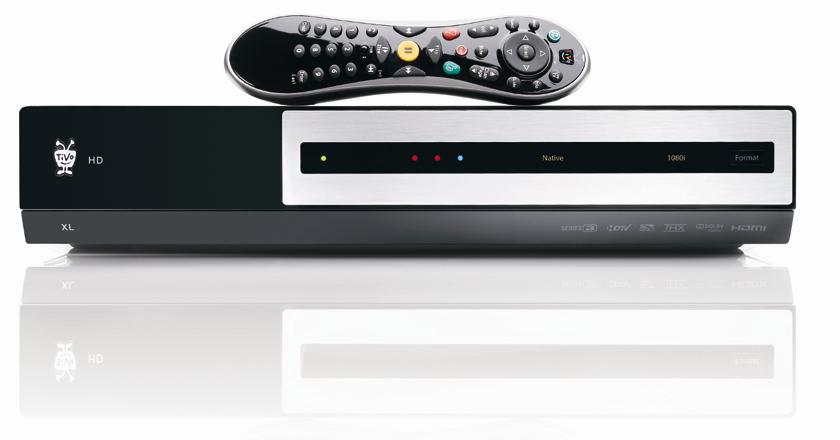
The TiVo HD is a fantastic HD DVR. The 160GB internal capacity and the $299.99 MSRP makes it a good fit for most users. However, with the discontinuation of the original TiVo Series3, TiVo is lacking a high end product. The Series3 not only came with 250GB of storage, but the back-lit TiVo Glo remote as well, and it had THX certification, which the TiVo HD lacks. The TiVo Series3 was aiming for a higher end market, as well as the custom installer trade.
Now, at CEDIA, TiVo is announcing their replacement for this market, the TiVo HD XL. The TiVo HD XL comes in at the $599.99 MSRP last occupied by the Series3. And like the Series3 it comes with the back-lit Glo remote and it is THX certified. While it lacks the fancy OLED front panel of the Series3 (physically it looks much like the standard TiVo HD, see photo above), it is a major step up in storage – with 1TB. Like the Series3, and unlike the TiVo HD, it also comes with an HDMI cable.
How does this extra capacity compare to the other units?
| Quality | Hours | ||
|---|---|---|---|
| TiVo HD | Series3 | TiVo HD XL | |
| HD | 20 | 32 | 150 |
| Best | 45 | 52 | 332 |
| High | 73 | 76 | 539 |
| Medium | 96 | 120 | 713 |
| Basic | 184 | 300 | 1,350 |
As you can see, that a substantial increase in recording capacity. And, just like the TiVo HD, the TiVo HD XL accepts an external eSATA drive. Currently only a 500GB drive is supported, though hopefully in the future 1TB eSATA drives will be available for TiVo. Unlike the Series3, but like the TiVo HD, the TiVo HD XL is locked down to only official drives.
While pre-upgraded 1TB TiVo HD units have been available from DVRupgrade and WeaKnees these don’t include the Glo remote and lack THX certification. And, since they’ve been upgraded, the cannot plug-and-play with an eSATA drive. And while the MSRP is $599.99, it is likely to sell for noticeably less online.
Note how, despite an additional 90GB, the Series3 doesn’t have much more capacity at the higher quality analog recording levels. This seems to be due to the THX certification requiring a higher encoding bit rate.
As far as the software goes, aside from the THX certification and likely associated tweaked analog encoding bit rates, the TiVo HD XL runs the same software, and therefore has all the same features, as the current TiVo HD.
The model number of the new unit is TCD658000 and it should be carried soon my major retailers such as Amazon, Best Buy, Circuit City, and others. There should also be a FAQ online later today.
TiVo was kind enough to offer me a review unit, but after talking to them I declined. I reviewed, and own, a TiVo Series3, and I reviewed the TiVo HD, so I know both the hardware and software. There didn’t seem to be a point in me using one of their review units when it would be just what I’m familiar with – but with a larger hard drive. Though I was tempted just so I could open it up and see if any o the chips changed.
The press release:
Continue reading
It has been rumored for a long, long time now that TiVo and DirecTV would reconcile and bring a new DirecTiVo to market. They’d been close partners until News Corp picked up a controlling share of DirecTV back in 2005. Shortly after that DirecTV switched their DVR technology provider from TiVo to NDS. NDS just happened to also be owned by News Corp. Many people felt that was the end of the DirecTiVo.
Just over a year ago TiVo and DirecTV announced that they’d be bringing additional software updates to the existing DirecTiVo units. That arrived earlier this year as 6.4a, showing that the relationship was still alive. The one cloud of doubt was in December when DirecTV acquired the remains of ReplayTV.
But then Liberty Media completed their acquisition of News Corp’s share of DirecTV in March, raising hopes. With News Corp out of the picture, NDS was no longer ‘in the family’. And Liberty Media is an investor in TiVo, giving them some incentive to have DirecTV work with TiVo again.
And today TiVo announced that a new TiVo-based HD DVR is being developed for DirecTV. Actually, from the language of the press release, I suspect it is a software load for DirecTV’s existing HR20 & HR21 HD DVRs, and not a new hardware platform.
Under the terms of the non-exclusive arrangement, DIRECTV and TiVo will work together to develop a version of the TiVo® service for DIRECTV’s broadband-enabled HD DVR platform. The product will support the latest TiVo and DIRECTV features and services, including TiVo’s Universal Swivel Search and TiVo KidZone. TiVo will develop the new HD DVR for an expected launch in the second half of 2009.
The phrasing “a version of the TiVo service for DIRECTV’s broadband-enabled HD DVR platform” makes me think that it will be similar to the platform developed for Comcast and Cox, software that can be loaded on the existing units. Since DirecTV doesn’t have an OCAP/tru2way-style platform, it would probably be a new software load which would replace the default system software. Alternatively it could be a new box developed from the TiVo HD platform, we know the DVB-T reference box could also form the basis of a DVB-S satellite unit, and a DBS unit would be similar.
And it also seems to make more sense in context:
DIRECTV will continue to develop and offer its own portfolio of industry leading set top boxes as primary offerings to both new and existing customers. This new TiVo box will be offered as an alternative choice to those DIRECTV customers who would like to add TiVo to a full line up of DIRECTV services.
This also sounds like Comcast, with TiVo being a premium alternative to the standard DVR. But it would be very expensive for DirecTV to maintain two hardware DVR platforms – manufacturing, maintaining inventory, support, etc. So it makes more sense for them to have one platform that they can load different environments on. It could still be a hardware platform, I just don’t think it is as likely.
In any case, the new platform will be available in the second half of 2009, and“The product will support the latest TiVo and DIRECTV features and services, including TiVo’s Universal Swivel Search and TiVo KidZone.” The release doesn’t go into detail over which features will or will not be supported, but since DirecTV has their own video on demand service I’d bet that services such as Amazon Unbox, Jaman, and CinemaNow will not be making appearances on the new DirecTV platform. Pricing will be announced with the product launch next year.
What isn’t addresses is the current DirecTiVo platform. Does the announcement of a new platform which embraces the TiVo network features mean that the existing platform’s USB ports will finally be enabled for network support? Both the hardware and the software are capable of supporting network features on par with the standalone Series2 TiVo, and the only thing preventing it to date has been DirecTV’s business decision. Since they’re clearly ready to support network features, I do hope that their existing loyal (and long suffering) customers get some support as well.
Also, in an SEC filing, TiVo revealed that their general partnership with DirecTV has been extended five more years, from February 15, 2010 until February 15, 2015, with DirecTV having the right to extend it another three years, to February 15, 2018. While the specific financial terms of the new agreement have not been revealed, the filing has this to say:
As part of this new agreement, DIRECTV will pay a substantially higher monthly fee for households using the new high definition DIRECTV DVRs with TiVo than the fees for previously deployed DIRECTV DVRs with TiVo service. DIRECTV will continue to pay the current monthly fee for all households using only the previously deployed DIRECTV DVRs with TiVo service. The fees paid by DIRECTV are subject to monthly minimum payments that escalate during the term of the agreement starting in 2010 and those minimum payments are substantially higher than in the prior agreement.
So subscribers using the new platform will be worth more to TiVo, and they have a guaranteed minimum level of revenue, which gives DirecTV some incentive to sign up subscribers fro the new platform. If they’re going to have to pay the fees anyway they may as well have clients using it. And if that isn’t enough:
DIRECTV is also obligated to annual marketing commitments, including significant cross-channel promotion of the high definition DIRECTV DVR with TiVo service to be developed by TiVo.
It sounds like a good deal for TiVo and DirecTV both. They also agreed to extend their covenant not to assert their patent rights against each other. Which could be why DirecTV picked up ReplayTV, as I speculated at the time. Holding ReplayTV’s DVR patents gives DirecTV a stronger hand when dealing with TiVo and their patents. The agreement extension also covers TiVo’s ability to sell advertising and perform audience measurement activities on DirecTV’s DVRs with TiVo service.
Today is a good day for fans of TiVo and DirecTV – but it will be an even better day when it ships next year.
I’ve been checking regularly for the past few hours, and Google Chrome is now available for download for Windows XP/Vista. As I said, it sounds interesting, looking forward to checking it out. (It is installing now.)
There have long been rumors that Google was working on its own browser, but they were discounted by most. I didn’t really believe them myself, since Google has heavily backed Mozilla’s Firefox for a long time now I figured that was their presence in the browser market. Or that if they did produce a Google-branded browser, that it would pretty much be just Firefox with a new skin. In the same way AOL skinned Mozilla Suite, and then Firefox, for their last versions of the Netscape browser. And pushing the limit, maybe something new built around Mozilla’s Gecko rendering engine, like Camino for the Mac.
When I didn’t expect was a nearly all-new browser which takes a clean sheet approach to browser design and changes some of the fundamental elements that have been common to browsers for a while now. But then again, this is Google, I probably shouldn’t be surprised that that is exactly what they’ve done with Google Chrome. It has been outed on the Official Google Blog, and interestingly via a 38-page comic book Google commissioned. I have to say, the comic format really worked for me. It made it somewhat entertaining, yet all of the elements were clear and understandable. Of course, I’m a geek and I’ve been doing web development since 1991. The first browser I used was Cern’s command line browser. (I won’t go into old-man mode and say ‘and we liked it that way’ – because, frankly, it sucked. I’m much happier with today’s browsers, believe me.)
Word got out prematurely when hard copies of the comic were received by bloggers early, and it was scanned and posted to Google Blogoscoped, which also followed up with some more information. The official launch is planned for later today (September 2nd). I’m looking forward to checking it out, it sounds like an interesting project. (I’m amused, but not surprised, that it already has a Wikipedia page.)
Of course, it is entering a market full of competitors. Microsoft’s Internet Explorer still dominates the Windows market, and I have to admit IE8 looks to be shaping up to be a fairly decent browser so far, based on the beta releases. Safari has a strong hold on Mac users. Firefox is the number two browser overall, a popular choice on Windows and giving Safari a run on Mac. Opera is still chugging along, though it is really not a strong player on desktops overall. Opera seems to have found more success on embedded and mobile devices.
Interestingly, Google Chrome’s rendering engine is based on Apple’s Webkit. That’s the engine at the core of Safari on the Mac, Windows, and, of course, the iPhone/iPod Touch. (And it evolved from the KHTML engine from the KDE project’s Konqueror browser.) Webkit is also used as the core of the browser in Google’s Android mobile platform, as well as in the browser included on Nokia’s Symbian Series60 mobile devices. It has also been used in a number of other products.
However, Google Chrome appears to only using the WebCore layout and rendering component from WebKit, and not the JavaScriptCore scripting engine. Instead Google has selected a new JavaScript engine from V8 in Denmark. They’ve taken a new approach to JavaScript engines which is designed to offer improved performance, especially when running increasingly complex web applications. Under the covers it offers better memory management and garbage collection, which should help make things more stable and reduce memory bloat.
Those seem to be three of the major goals of Google Chrome, better performance, better stability, and reduced memory leaks/bloat, along with a fourth goal, improved security. They’ve changed the way browser processes are handled, offering better sandboxing to protect the system from malicious web apps. Google’s anti-phishing and anti-malware filters are also built into Chrome. (These are also offered in Firefox.) Google Gears is also included with Chrome, which will help performance with websites and web applications that use the Gears API. (For example, WordPress supports Gears on the admin interface to improve performance.)
And the best part is that Google is releasing Chome as open source. So all of the work they’ve done, and will do, is available to other developers and vendors to borrow and learn from. It sounds like they’ve done some very interesting things, so there are probably a few things others could learn from this.
Getting users to adopt Chrome is going to be the hard part. Firefox has been out for years and still has a small minority of the market. IE is still hovering around 70% of browser traffic in the Internet. People tend to use what is in front of them, for better or for worse. And with the current IE, that’s for worse. While IE7 is light years ahead of IE6, that’s not saying much as IE6 was utter crap. IE8 does look like it will help, but until it is out of beta most users won’t run it. Even once it is out of beta, unless MS pushes it as an automatic update, most users never upgrade.
For me I’ll have to see how Chrome performs, what the new UI is like, and what features it offers. I’ve never been a fan of Opera because I couldn’t stand the UI choices they made. It just didn’t suit me. I’ve played with Safari, and it wasn’t bad, but it wasn’t that appealing. Certainly not enough to sway me from Firefox. I like the Firefox UI, I’m sure in large part because it has evolved steadily from the old Netscape UI. I started using Netscape when it was still around .9, up through 4.79. Then I switched to Mozilla Suite. And finally to Firefox after it hit 1.0. But also because of the extensions that allow me to customize it to my tastes and needs, as I recently covered.
As intrigued as I am by the new design direction Google has taken, it will come down to usability and functionality. I think Google probably has better odds of winning me over than any other player to date, especially if they can deliver on the performance and security. It will be interesting to see if they offer any synchronization between Google Chrome and the browser on Android. Being able to transparently store my browser preferences, bookmarks, etc, ‘in the cloud’ and access them from any Google browser would be a big appeal for me.
You know, with all of Google’s web-based applications (Gmail, Google Docs, Google Calendar, Google Reader, etc), they’re really close to being able to release a Google PC. From what I’ve seen Android could make a decent OS for a ‘netbook’ style computer, and Chrome could provide the main application environment.