A slew of consumer electronics and consumer advocacy groups seem to have taken issue with a recent NCTA filing with the FCC, in which they argued against AllVid and for allowing the cable industry to basically do as they pleased. The AllVid Tech Company Alliance, Consumer Electronics Association, Consumer Electronics Retailers Coalition, Media Access Project, New America Foundation, and Public Knowledge all jointly responded with a filing of their own, refuting the NCTA’s claims and arguing strongly for AllVid.
It is probably obvious where my sympathies lay, I think we need AllVid. While the cable industry, through the NCTA, argues that a mish-mash of MVPD-unique apps to bring content to phones and tablets is all we need, that allowing each MVPD to slap their interface across any device is innovative, and that the industry should decide how open it needs to be, I do not agree. I feel that all of these are just more of the same. Same shit, different device. Cable system user interfaces almost universally suck, I don’t want that UI on my CE devices. That kind of solution was a major factor in the failure of tru2way. Consumer electronics vendors – like TiVo, Sony, Samsung, etc. – should be able to create one UI that works with all MVPDs, not have to make deals with them one at a time and create unique apps to work with each one.
For just one example look at TiVo’s efforts to support cable OnDemand on their DVRs. They have to invest a lot of time and effort in just lobbying each MSO to make a deal. And once they’ve made the deal they have to implement a variant on their solution to deal with the different MSO requirements, because there is no standard. Consumers get screwed in the end because we get a pot luck of solutions. If you want OnDemand from RCN, Suddenlink, or (soon) Charter, then you need to get your box from them. Oh, but then you have to give up Netflix, and possibly other OTT content. You’ll be able to use your retail box with Comcast or Cox. But you’re SOL with Cablevision, Time Warner Cable, Brighthouse, FiOS, etc. Of course, you can’t even use a modern TiVo with DirecTV, Dish Network, or AT&T U-Verse, because they’re closed, proprietary networks.
And that’s what AllVid is about – providing standard interfaces and opening up networks to real competition and innovation in CE devices. The NCTA claims that if the original AllVid proposal were in effect we wouldn’t have the iPad apps, etc., we do today. I think that’s bullshit. My understanding of the original proposal is that it wouldn’t forbid development of these apps alongside providing an open, IP-based interface for 3rd parties. It wouldn’t tell cable companies they had to stop innovating, just that they would also need to provide the required standard interfaces to their content streams.
The FCC filing makes their feelings pretty clear:
The featured list of “innovative approaches” that begins on the first page of the NCTA letter includes not a single thing that would make MVPD programming or services available on competitive devices. Rather, “progress” is cited in these areas:
- Internet delivery of some “cable video”
- Extensions to a few specified portable devices
- IP-based interfaces that deliver only the MSOs’ own guides to their own leased settop boxes
- Limited availability of standards-based home networking
- Reliance on “cloud” delivery
Citing these advances as a “march of progress,” however, merely continues NCTA’s tactic over the last 15 years of pointing to incremental achievements to sidestep or forestall proposals from the Commission and the consumer electronics, information technology, retailer, and public interest sectors that would achieve the goals of Section 629 in full. The reality is that greater progress in device interoperability and home networking has been achieved in other sectors, such as Internet-based video delivery, where competition exists.
We need the equivalent to Carterfone for MVPDs. The Carterfone decision forced telcos to open up their networks to 3rd party devices. No longer did consumers have to get their telephones from the telco. It opened the market up to an endless variety of competing phone designs, to answering machines, fax machines, and, probably most important of all, to modems. Without the open access provided by Carterfone, who knows how much innovation would’ve been retarded. Before the decision the telcos certainly weren’t moving very quickly to introduce new devices. They were happy with the status quo.
We’re in a similar situation today with MVPDs. CableCARD is such a pain to deal with, and so limited, that CE vendors just avoid the market. So we have a dearth of options to choose from. HDTV makers have actually pulled back from including CableCARD tuners. TiVo is really the only notable CableCARD product available to consumers. Moxi has basically dropped out of the market. And there are a handful of CableCARD tuner products for PCs, but they’re a fairly small niche.
Remember the days before digital cable, when analog cable was basically wide open? There were scores of ‘cable ready’ devices. Nearly every TV & VCR had a cable tuner. There were many DVR & DVR recorder products available. But as cable moved to digital the MSOs used the opportunity to lock out 3rd parties by encrypting the signal. That’s what CableCARD was supposed to solve, but the final solution is so flawed as to make it nearly non viable. And the MSOs have done a lot to discourage use, while the FCC has only addressed the issues slowly and piecemeal – like the upcoming self-install mandate. And, of course, after we got CableCARD SDV came along, adding more pain with tuning adapters. And, of course, OnDemand and Pay Per View content isn’t supported.
I want to go back to those analog cable days, at least in terms of consumer choice. When you could walk into a store and select from a wall of VCRs, DVRs, or DVD Recorders. When you could buy most any TV, plug it into your cable, and access all of the content you were paying for. Today, even if you’re willing to deal with CableCARD, the choices just aren’t there because the pain is enough to keep CE vendors from entering the market. Those that tried when CableCARD was new got burned. And the CE industry has been burned multiple times by cable, remember the June 2008 pledge to have tru2way fully deployed by July 2009 (July 2010 for Charter)? Yeah, how’d that go? This is why the CE industry is wary of just leaving things up to the cable industry. When they do, they get screwed – along with consumers.
CableCARD technically works, but it is a complete failure when it comes to the original goals. The cable industry has managed to make CableCARD so painful that it isn’t worth dealing with. But CableCARD was always meant as an interim solution on the way to something better – and that something better is AllVid. It’d restore the balance that existed before the digital lock out. CE vendors could product products that only needed to support one standardize interface to handle cable, satellite, IPTV, etc. Linear content, SDV, OnDemand, and PPV would all be supported. CE vendors would be free to create their own UI to differentiate their products, like a TiVo Search that provides unified results from linear content, VOD, PPV, and OTT content (Netflix, YouTube, etc.)
The cable industry doesn’t like this because they want to control every aspect of the consumer relationship. They don’t want you to have a choice. They want you to use a Comcast STB at home with a Comcast UI, and a Comcast app on your phone or tablet. They want to control everything end to end, so it isn’t as easy to turn to Netflix, Amazon, etc., for content. They want to lock the consumer in and put up barriers to choice, but making it too much trouble, if not impossible, for CE vendors to create innovative products that blur the lines.
The NCTA points to TiVo’s work with VOD as a reason we don’t need AllVid – I say it is exactly why we do need it. If we had AllVid TiVo could’ve implemented and deployed VOD by now – for all MSOs, not to mention satellite support. And so could every other CE vendor. Right now TiVo has negotiated deals with five cable MSOs, but if Sony wants to implement VOD support they’ll have to negotiate their own individual deals. Samsung would have to do the same. And LG. Etc. It is slow, cumbersome, and expensive.
If you’ve ever wondered why you don’t have VOD or PPV on your TiVo, or why you can’t use TiVo with satellite, or if you’ve ever lamented the quality of the software on your provider’s STB and wished for choice, or were frustrated by online access to your provider’s content being iPad online and not on Android, or your PC or Mac, or if you just want to be able to have choice as a consumer, then you should be in favor of AllVid.
I’m glad to see these groups out there keeping the pressure on the FCC through their filings. I know many of them have their own interests, but I believe those interests better align with consumer interests than the cable industry’s do. Carterfone didn’t kill the telcos, in fact it was one of the best things that ever happened to them as the innovations that followed increased usage of the PSTN, which meant increased revenues. Likewise, AllVid won’t kill the MVPDs. I think it would create a surge in demand for their services as people would have many new ways to access the content and unlock the value therein, currently trapped in a narrow scope of applications.


 We all know the FCC has mandated CableCARD self-installs, and FiOS, Cox, and Cablevision are already on board, with TWC on deck, but what about Comcast?
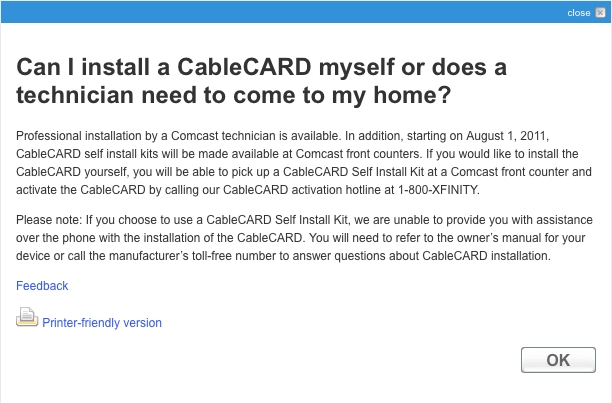 Interestingly, back in June Comcast had a page on their site which made things perfectly clear – but I can’t find any sign of the page, or anything similar, on their site today. And here’s a screencap from back then as proof – click on it for a larger version. The text is: