BBC Big Screen iPlayer to be Integrated with Virgin Media TiVo EPG

Virgin Media TiVo One of the few complaints lodged against the Virgin Media TiVo is that the BBC iPlayer is disconnected from the rest of the system. It lives as a separate app, and isn’t integrated into the ‘catch-up’ EPG, etc. While BBC iPlayer on older Virgin Media boxes, like the V+, was tightly integrated.

But it turns out this wasn’t Virgin Media’s, or TiVo’s, fault, but the BBC’s doing. The iPlayer used on the VM TiVo platform is their new ‘Big Screen’ iPlayer and they require it to be less integrated than the old player that was used on earlier boxes, as detailed by paidContent:UK (all emphasis in the original):

But, as iPlayer moves from PC to TV as a branded service, platforms like BSkyB and FetchTV would rather carry individual BBC programmes in their own EPGs, just as they do with live programming – something BBC syndication guidelines forbids.

Virgin Media’s new TiVo box is amongst those now forced to carry the badged Big Screen iPlayer in an “apps” section, separate from all Virgin’s other VOD, even though its previous V+ box had closely integrated BBC catch-up shows. All broadcasters are doing the same. Connected TVs are increasingly shipping with iPlayer, ITV Player, 4oD, Demand Five and, perhaps soon, Sky Player, resulting in VOD becoming siloed.

Fortunately, according to BBC on-demand GM Daniel Danker, this should be changing and integration should improve:

“This is a strange moment in time that I hope will be very, very short-lived,” Danker tells paidContent. “We are offering any provider our full metadata for everything we have in iPlayer.” That means the likes of Virgin, Fetch and BT Vision will be free to include BBC catch-up prompts in their own EPG, but clicks will deep-link out to the individual programme on Big Screen iPlayer.

It means box operators can own the initial discovery experience but the BBC will retain the subsequent viewing experience. Virgin Media is currently working with this metadata to improve its TiVo, Danker says.

This is good news for Virgin Media TiVo users. While it sounds like it won’t be as seamlessly integrated as in the past, it seems it will be a big improvement over the current state of affairs once the work to integrate the BBC iPlayer metadata is complete. Most of the complaints have focused on disappointment over the iPlayer content not appearing in the EPG and in search results, and it sounds like those issues, at least, will be solved. I don’t think users will care that they’ll be deep-linking out to programs in the standalone iPlayer.

Posted in Broadband, DVR, TiVo | Tagged , , , , | Leave a comment

EFF Campaign to Stop the FCC from Granting Integration Ban Waivers to Cable MSOs

FCC Logo I noticed something odd today, three nearly identical comments filed on FCC proceeding 97-80 (1,2,3). I knew someone must be coordinating the comments, so I searched, and sure enough, it if an effort organized by the EFF.

The body of their suggested letter reads:

As a consumer interested in protecting competition, innovation, and legitimate use of cable TV content, I urge you to refuse requests for waivers of 47 CFR 76.1204(a)(1) by NCTA, Charter, Verizon, and all other cable providers. The FCC’s integration ban, which in effect requires cable companies to integrate CableCARDs into their own set-top boxes, remains good policy today.

Now ten years after the Telecommunications Act of 1996, cable companies have dragged their feet long enough on competitive alternatives to proprietary set-top boxes, thus hampering innovation and harming consumers. The integration ban will also help market competition prevent further restrictions on cable subscribers’ ability to make legitimate use of recorded content.

By adopting content protection limits (encoding rules) in docket no. 97-80, the Commission recognized the importance of allowing consumers to make certain uses of TV content, regardless of a particular cable provider’s or copyright holder’s wishes. With competition spurred on by the integration ban, consumers would have the freedom to choose the least restrictive cable-compatible device available. The CableCARD standard already prescribes restrictions that harm consumers by limiting non-infringing uses, and such restrictions will get even worse if cable providers’ set-top boxes are unchecked by competition.

Please refuse requests for waivers of 47 CFR 76.1204(a)(1).

I decided to toss my support behind this effort as well, and I inserted some text of my own:

As a tech blogger I’ve followed the evolution of CableCARD closely, and it has been a string of disappointments. Between the delays, the limitations on what UDCPs may support, the unpalatable requirements of OCAP/tru2way which discouraged CE vendors, the broken promise to fully deploy tru2way by July 2009 (July 2010 for Charter – it is now August 2011), SDV and Tuning Adapters, MVPDs having to be forced to allow self-installs and to use fair pricing, etc., etc., they have an extremely poor track record.

As an IT professional I know the value in “eating your own dog food”. When cable MSOs were required to begin using CableCARD in their own devices, overall support improved. Of course, they took shortcuts by pre-pairing the cards and permanently installing them in their STBs, so they didn’t need to use the same installation and activation process, but it still exercised the infrastructure. They should be forced to continue using CableCARD until such time as a new system, such as AllVid, is available to *all* devices.

I believe that cable MSOs should be required to use the same systems available to consumer electronics companies. This helps to force them to improve the systems for their own sake, and not neglect them unfairly. I think it would also put pressure on them to work toward a better solution, like AllVid, which would benefit all parties – especially consumers. If they’re allowed to roll their own solutions, independent of what is available to CE vendors, they have little to no incentive to adopted unified, open standards and robust systems for CE products.

Posted in Cable, FCC, OCAP | Tagged , , , , , , | 5 Comments

TiVo Premiere Elite Features Detailed in FCC Filing

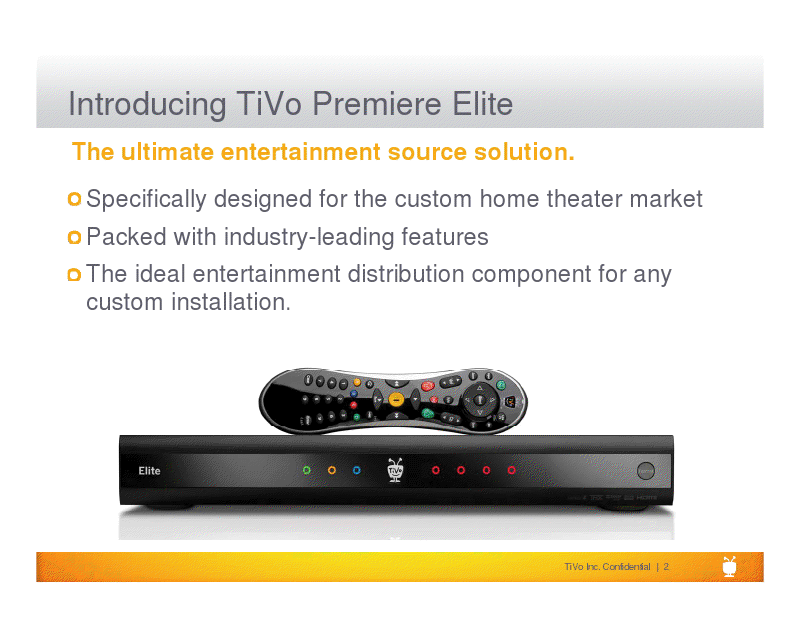
TiVo Logo TiVo would have to put something out on the one day I’m not glued to the net. I saw this this morning in my FCC RSS feeds in Google Reader on my Droid, but I’m just getting a chance to sit down with my laptop and WiFi to post it. This is related to my post from yesterday about TiVo’s last FCC filing, in which they revealed the intended retail plans and time frame for the TiVo Premiere Elite. In today’s filing they go further, revealing “TiVo Premiere Elite Training” slides which detail many of the product features. The full filing is at the FCC, but I’ve also uploaded it here for posterity, just in case.


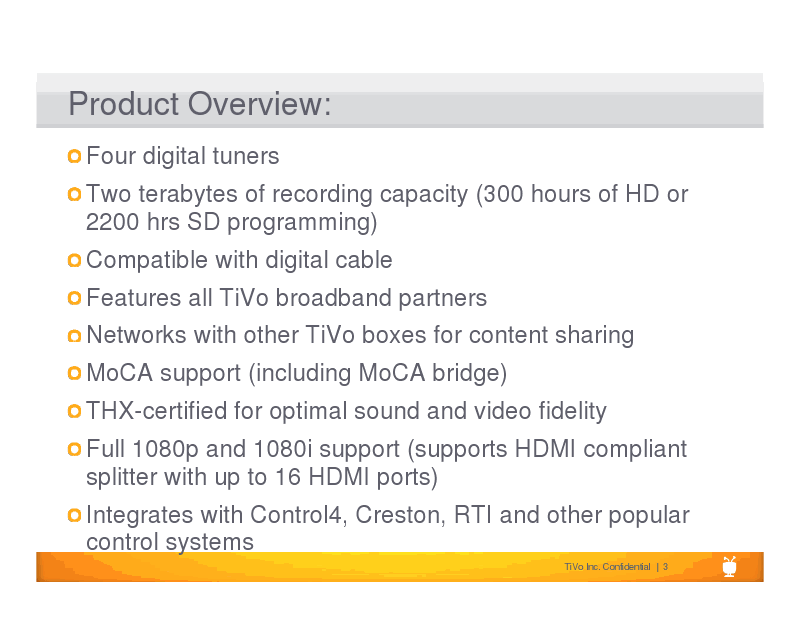
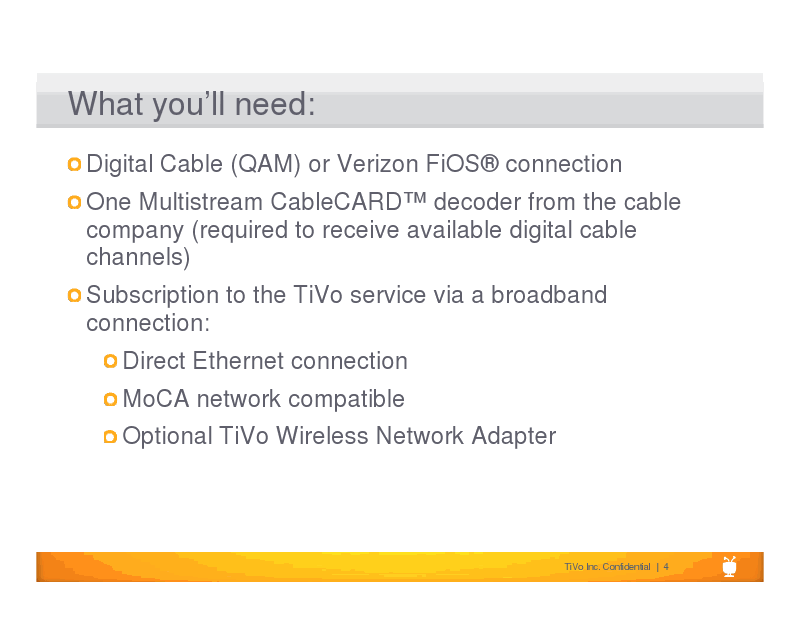
To make it easier to view the slides I’ve saved them out separately:


As the training slides makes clear, the retail TiVo Premiere Elite is basically identical to the MSO-oriented TiVo Premiere Q, announced in June.

Key points:

  • Targeted at the custom home theater market – which means it isn’t going to be cheap. Given the current Premiere/Premiere XL $99.99/$299.99 pricing, I expect this to be at least $499.99, and possibly much more.
  • Four digital (QAM) tuners
  • 2TB of storage – 300 hours of HD or 2200 hours of SD recordings
  • Supports all TiVo broadband partners (Amazon, Netflix, Blockbuster, Hulu, YouTube, etc.), unlike MSO boxes which lack some of these (notably Netflix) due to contract limitations.
  • Network content sharing with other TiVo boxes – the Premiere & Premire XL, and probably the Preview if that ever comes to retail. This seems to be streaming, which we know is coming.
  • MoCA support, including MoCA bridge. This was a feature of the Premiere Q some were unsure would make it to retail.
  • THX-certified, as befits a high end box.
  • Full 1080p and 1080i support, including HDMI compliant splitters for up to 16 HDMI ports. We’ll see what ’1080p’ means. The TiVo Premiere has 1080p support – but only 1080p24 pass-through, no upscaling, no 1080p60, etc.
  • Supports Control4, Crestron (misspelled in the slide as ‘Creston’), RTI, and other control systems. I’m guessing this is the network remote feature that is in the Series3 and later boxes.

To use the Premiere Elite you’ll need digital cable (QAM) or Verizon FiOS, one Multi-stream CableCARD (M-Card), and a subscription to the TiVo service. The unit will need to be connected to the network – Ethernet, MoCA, or WiFI (using a TiVo WiFi adapter). There is no mention of a phone line adapter, available for the Premiere/Premiere XL, but who’s really going to buy such a high end unit and use a phone line anyway?

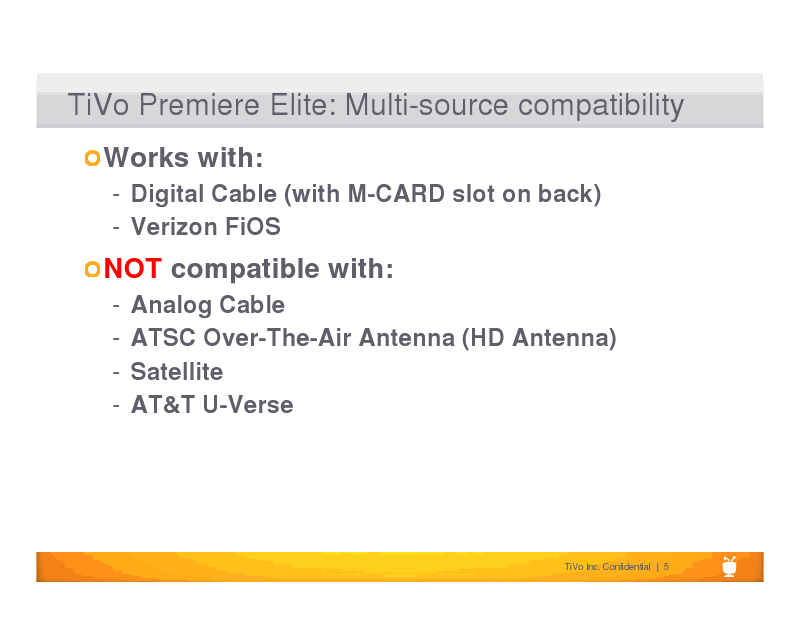
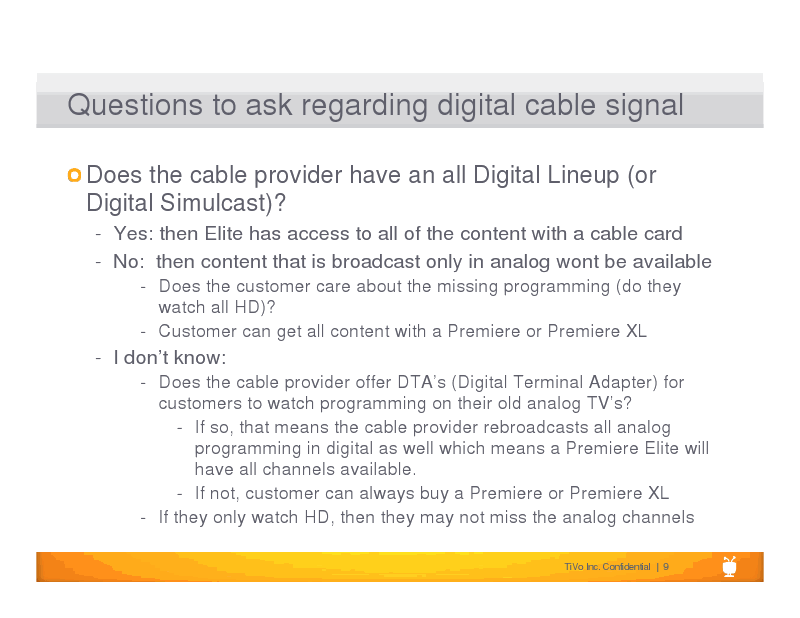
The training materials make it clear that it is NOT compatible with analog cable, ATSC/antenna, satellite, or AT&T U-Verse. This is a digital cable/FiOS only unit. OTA users start screaming… now. I wonder what factors went into the decision to block ATSC. It is still digital, and QAM/ATSC tuner blocks exist. With the growth in cord cutting this could’ve been kind of the hill for OTA users.

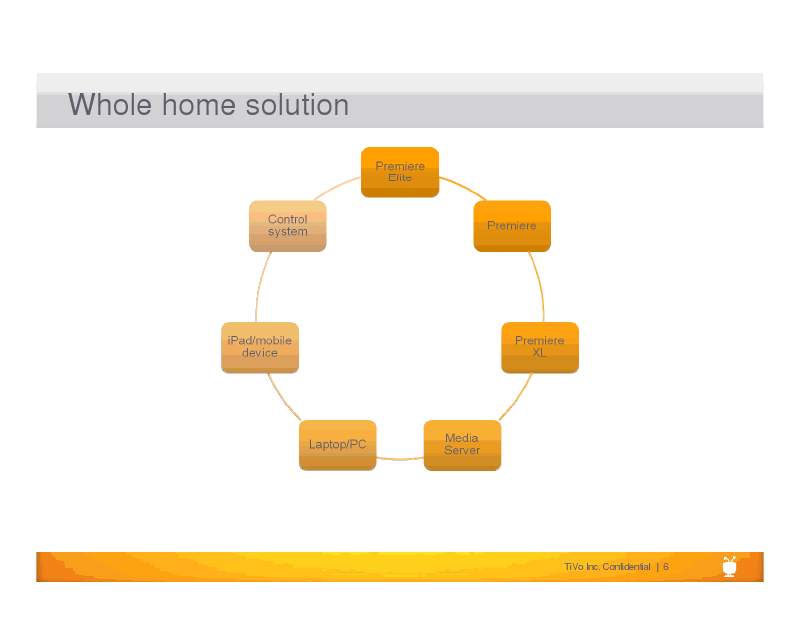
In the ‘Whole home solution’ slide they have a ‘circle of life’ showing the Premiere Elite, Premiere, Premiere XL, Media Server, Laptop/PC, iPad/mobile device, and Control system. (Note the TiVo Preview is not listed.) It isn’t clear if that refers to existing functionality that we’re aware of – TiVo Desktop, the existing iOS app, etc., or if there could be more. In mentioning a media server, could TiVo finally have implemented DLNA? With out without DTCP-IP? I really hope so, but I’m not holding my breath. With the new streaming support if would be nice if there were a client for other devices to receive the streams, not just another TiVo. For devices like the iPad, iPhone, Android phones, etc., which don’t handle MPEG2 well, could the Elite include transcoding for real placeshifting support? Again, I doubt it, but it really would be a nice addition.

In addition to the training slides, TiVo’s FCC filing includes additional information about their consumer education plans to handle the digital-only aspect of the product. The in-store data sheet will contain this notice:

CableCARD™ Decoder. A CableCARD decoder is required for your TiVo Premiere Elite DVR to receive an cable programming. The TiVo Premiere Elite is designed for use only with digital cable systems. It does not receive analog programming, including over-the-air, and will not work with an over-the-air antenna. Most of the largest cable providers have “digital simulcast,” which means they rebroadcast all their analog channel programming on digital channels as well. This means that all programs available on analog channels are also available on digital channels when a CableCARD is inserted. Therefore, if your provider has “digital simulcast” you will not miss any of your cable channel programming with a TiVo Premiere Elite. Please contact your provider if you are unsure whether its service provides digital simulcast of all analog programming.

The Quick Start Guide and User Guide will also make it clear:

a. Quick Start Guide — The Premiere Elite packaging includes a large (18″ x 24″), heavy-weight, glossy installation guide that includes the following prominent notice:

The TiVo Premiere Elite is intended for use with digital cable systems only and does not work with external cable boxes, analog cable, or over-the-air antennas. A CableCARD decoder is required to receive any cable programming. To receive digital cable channels, and to watch and record multiple channels at the same time, you need one Multi-Stream CableCARD decoder (M-Card) from your cable company.

b. User’s Guide — The detailed Premiere Elite information booklet included with all
units includes notifications essentially identical to those of the in-store “Data Sheet” described above.

This all gives us a tantalizing peak at the TiVo Premiere Elite. Now, if only the FCC would hurry up and grant that waiver.


Posted in Cable, DVR, FCC, TiVo | Tagged , , , , , , , , | 9 Comments

Lenovo’s Android Tablets

Lenovo IdeaPad K1 Tablet I’ve posted a lot about Android tablets, but I haven’t really covered Lenovo’s two offerings. One, the IdeaPad K1, is out now and is targeted at the average user. Amazon currently has it for $479.99. The second, the ThinkPad Tablet, is due out on August 23rd and is targeted at business users. The two tablets share similar specs – Android 3.1, Nvidia Tegra 2 1GHz dual-core processor, 10.1″ 1280×800 screen, 802.11b/g/n, Bluetooth, optional 3G, 1GB RAM, 16/32/64GB storage, 2MP front facing camera, 5MP rear facing camera, mini HDMI, etc. Fairly common specs for Android tablets these days.

Lenovo Thinkpad Tablet But they’re not just the same tablet with different labels. The IdeaPad K1 includes a microSD slot, while the ThinkPad Tablet has a full size SD slot. The ThinkPad also has a full size USB port, like the Toshiba Thrive, as well as a microUSB port. The ThinkPad Tablet also includes a pressure sensitive stylus for pen-based input, and there is an available keyboard dock which includes the Lenovo TrackPoint device. While the IdeaPad K1 has a single button on the front, the ThinkPad Tablet has four – home, back, browser, and a screen orientation lock. The ThinkPad Tablet is also more angular and ‘serious’ looking than the more curved IdeaPad K1, I’m sure that’s intentional styling for the different markets.

The pre-loaded apps are also different, with the IdeaPad focused on games, music, and entertainment apps, while the ThinkPad gets down to business with more business oriented apps like Citrix Receiver and the FlexT9 advanced virtual keyboard. Both do include Documents To Go, Angry Birds HD, and Netflix however, so you can take a break from fun to work, or take a break from work for some fun.

The IdeaPad K1 is 10.4” x 7.4” x .5” and 1.65 pounds, while the ThinkPad Tablet is 10.3″ x 7.2″ x .57″ and weighs 1.64 pounds with WiFi or 1.67 pounds with 3G. So they’re very similar in size and weight.

Posted in Android, Mobile Devices | Tagged , , , | Leave a comment

Virgin Media TiVo Users Get V Festival App

Virgin Media TiVo Demonstrating the flexibility provided by the new TiVo platform’s Flash application environment, Virgin Media has launched another custom app. This one is a bit of shameless cross-promotion, as it is connected to the upcoming V Festival, which is happening August 20th & 21st. The app allows users to view performances from past V Festivals by artists such as Amy Winehouse, The Proclaimers, and Snow Patrol. It also provides clips of artists who will be performing at this year’s V Festival.

I believe this is the second such tie-in app for the Virgin Media TiVo platform, the first being one to promote the latest Harry Potter film.

Posted in DVR, TiVo | Tagged , , | Leave a comment